
Technische gegevens
| Formule | C24H29FN6O5 |
||||||
| Moleculair gewicht | 500.52 | CAS-nr. | 915769-50-5 | ||||
| Oplosbaarheid (25°C)* | In vitro | DMSO | 100 mg/mL (199.79 mM) | ||||
| Water | 66 mg/mL (131.86 mM) | ||||||
| Ethanol | 1 mg/mL (1.99 mM) | ||||||
| In vivo (Voeg oplosmiddelen afzonderlijk en in volgorde toe aan het product.) |
|
||||||
|
* <1 mg/ml betekent licht oplosbaar of onoplosbaar. * Houd er rekening mee dat Selleck de oplosbaarheid van alle verbindingen intern test en de werkelijke oplosbaarheid enigszins kan afwijken van gepubliceerde waarden. Dit is normaal en is te wijten aan lichte batch-tot-batch variaties. * Verzending op kamertemperatuur (Stabiliteitstests tonen aan dat dit product zonder koelmaatregelen kan worden verzonden.) |
|||||||
Voorbereiden van stamoplossingen
Biologische activiteit
| Beschrijving | Dovitinib (TKI258) Lactaatmonohydraat is het lactaat van Dovitinib, een multigetargete RTK-remmer, voornamelijk voor klasse III (FLT3/c-Kit) met een IC50 van 1 nM/2 nM, ook potent voor klasse IV (FGFR1/3) en klasse V (VEGFR1-4) RTK's met een IC50 van 8-13 nM, minder potent voor InsR, EGFR, c-Met, EphA2, Tie2, IGFR1 en HER2. Fase 4. | |||||||||||
|---|---|---|---|---|---|---|---|---|---|---|---|---|
| Doelen |
|
|||||||||||
| In vitro | Dovitinib remt krachtig de FGF-gestimuleerde groei van WT en F384L-FGFR3-expresserende B9-cellen met een IC50 van 25 nM. Bovendien remt Dovitinib de proliferatie van B9-cellen die elk van de verschillende geactiveerde mutanten van FGFR3 tot expressie brengen. Interessant is dat er minimale verschillen worden waargenomen in de gevoeligheid van de verschillende FGFR3-mutaties voor Dovitinib, waarbij de IC50 varieert van 70 tot 90 nM voor elk van de verschillende mutaties. IL-6-afhankelijke B9-cellen die alleen vector bevatten (B9-MINV-cellen) zijn resistent tegen de remmende activiteit van Dovitinib bij concentraties tot 1 μM. Dovitinib remt de celproliferatie van KMS11 (FGFR3-Y373C), OPM2 (FGFR3-K650E) en KMS18 (FGFR3-G384D) cellen met een IC50 van respectievelijk 90 nM (KMS11 en OPM2) en 550 nM. Dovitinib remt FGF-gemedieerde ERK1/2-fosforylatie en induceert cytotoxiciteit in FGFR3-expresserende primaire MM-cellen. BMSC's geven een bescheiden mate van resistentie met 44,6% groeiremming voor cellen behandeld met 500 nM Dovitinib en gekweekt op stroma, vergeleken met 71,6% groeiremming voor cellen gekweekt zonder BMSC's. Dovitinib remt de proliferatie van M-NFS-60, een M-CSF-groeigedreven muis-myeloblastische cellijn met een mediane effectieve concentratie (EC50) van 220 nM. Behandeling van SK-HEP1-cellen met Dovitinib resulteert in een dosisafhankelijke vermindering van het aantal cellen en G2/M-fase-arrest met vermindering in de G0/G1- en S-fasen, remming van ankeronafhankelijke groei en blokkade van bFGF-geïnduceerde celmotiliteit. De IC50 voor Dovitinib in SK-HEP1-cellen is ongeveer 1,7 μM. Dovitinib vermindert ook significant de basale fosforylatatieniveaus van FGFR-1, FGFR-substraat 2α (FRS2-α) en ERK1/2, maar niet Akt, in zowel SK-HEP1- als 21-0208-cellen. In 21-0208 HCC-cellen remt Dovitinib significant de bFGF-geïnduceerde fosforylatie van FGFR-1, FRS2-α, ERK1/2, maar niet Akt. |
|||||||||||
| In vivo | Dovitinib induceert zowel cytostatische als cytotoxische reacties in vivo, wat resulteert in regressie van FGFR3-expresserende tumoren. Dovitinib vertoont een dosis- en blootstellingsafhankelijke remming van doelreceptor-tyrosinekinasen (RTK's) die tot expressie komen in tumorxenografts. Dovitinib remt krachtig de tumorgroei van zes HCC-lijnen. Remming van Angiogenesis correleerde met inactivatie van de FGFR/PDGFRβ/VEGFR2-signaleringsroutes. In een orthotoop model remt Dovitinib krachtig de primaire tumorgroei en longmetastase en verlengt het de overleving van muizen significant. Toediening van Dovitinib resulteert in significante tumorgroeiremming en tumorregressies, inclusief grote, gevestigde tumoren (500-1.000 mm3). |
Protocol (uit referentie)
| Kinase-assay: |
|
|---|---|
| Celassay: |
|
| Dierstudie: |
|
Referenties
|
Klantproductvalidatie

-
, , Genome Biol, 2014, 15(8):428.

-
Gegevens van [ , , Neoplasia, 2013, 15(8):975-88 ]
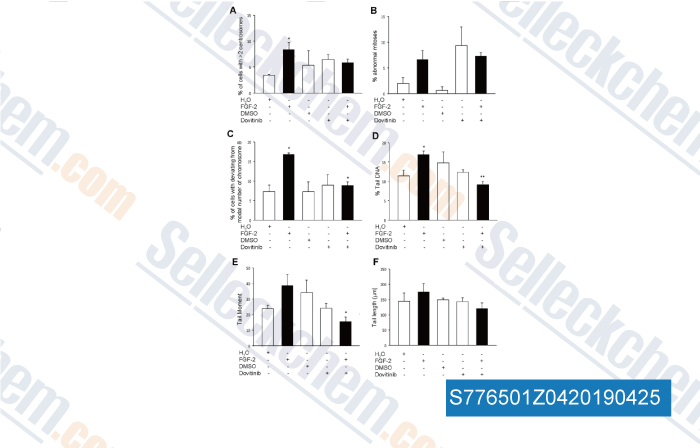
-
Gegevens van [ , , Urol Oncol, 2018, 36(8):365 ]
-
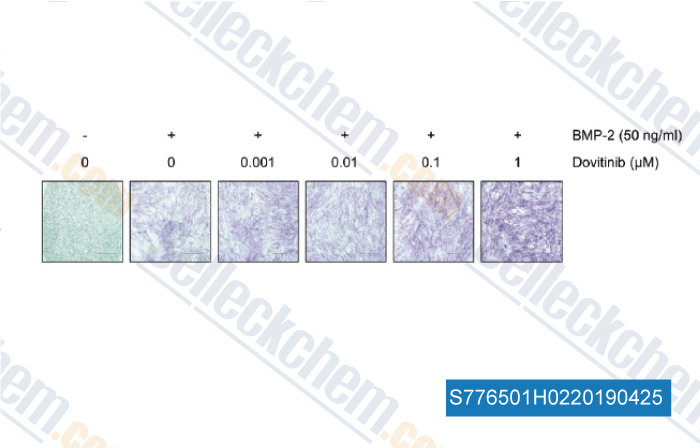
Gegevens van [ , , Mol Cells, 2016, 39(5):389-94 ]
Sellecks Dovitinib (TKI258) Lactate monohydrate Is geciteerd door 31 Publicaties
| Lysine acetylation restricts mutant IDH2 activity to optimize transformation in AML cells [ Mol Cell, 2021, S1097-2765(21)00507-4] | PubMed: 34289383 |
| Targeting fibroblast growth factor receptors to combat aggressive ependymoma [ Acta Neuropathol, 2021, 10.1007/s00401-021-02327-x] | PubMed: 34046693 |
| Newly identified members of fibroblast growth factor receptor 1 splice variants engage in crosstalk with the AXL/AKT axis in salivary adenoid cystic carcinoma [ Cancer Res, 2021, canres.1780.2020] | PubMed: 33408119 |
| Effects of FGFR Tyrosine Kinase Inhibition in OLN-93 Oligodendrocytes [ Cells, 2021, 10(6)1318] | PubMed: 34070622 |
| Entrectinib Induces Apoptosis and Inhibits the Epithelial-Mesenchymal Transition in Gastric Cancer with NTRK Overexpression [ Int J Mol Sci, 2021, 23(1)395] | PubMed: 35008821 |
| TRK inhibitors block NFKB and induce NRF2 in TRK fusion-positive colon cancer [ J Cancer, 2021, 12(21):6356-6362] | PubMed: 34659525 |
| TRK inhibitors block NFKB and induce NRF2 in TRK fusion-positive colon cancer [ Journal of Cancer, 2021, 12(21): 6356-6362] | PubMed: None |
| Comprehensive pharmacogenomic characterization of gastric cancer. [ Genome Med, 2020, 18;12(1):17] | PubMed: 32070411 |
| Effects of FGFR inhibitors TKI258, BGJ398 and AZD4547 on breast cancer cells in 2D, 3D and tissue explant cultures [ Cell Oncol (Dordr), 2020, 10.1007/s13402-020-00562-0] | PubMed: 33119860 |
| Anti-Proliferative Effect of Allium senescens L. Extract in Human T-Cell Acute Lymphocytic Leukemia Cells [ Molecules, 2020, 26(1)E35] | PubMed: 33374788 |
RETOURBELEID
Selleck Chemicals onvoorwaardelijke retourbeleid zorgt voor een soepele online winkelervaring voor onze klanten. Als u op enigerlei wijze ontevreden bent met uw aankoop, kunt u elk artikel(en) binnen 7 dagen na ontvangst retourneren. In geval van problemen met de productkwaliteit, zowel protocolgerelateerde als productgerelateerde problemen, kunt u elk artikel(en) binnen 365 dagen na de oorspronkelijke aankoopdatum retourneren. Volg de onderstaande instructies bij het retourneren van producten.
VERZENDING EN OPSLAG
Selleck producten worden bij kamertemperatuur vervoerd. Als u het product op kamertemperatuur ontvangt, wees dan gerust, de Selleck kwaliteitsinspectieafdeling heeft experimenten uitgevoerd om te controleren of de normale temperatuurplaatsing van één maand de biologische activiteit van poederproducten niet beïnvloedt. Na ontvangst dient u het product op te slaan volgens de vereisten beschreven in het gegevensblad. De meeste Selleck producten zijn stabiel onder de aanbevolen omstandigheden.
NIET VOOR HUMANE, VETERINAIRE DIAGNOSTISCHE OF THERAPEUTISCHE DOELEINDEN.