
Technische gegevens
| Formule | C18H26ClN3.2H3O4P |
|||
| Moleculair gewicht | 515.86 | CAS-nr. | 50-63-5 | |
| Oplosbaarheid (25°C)* | In vitro | Water | 100 mg/mL (193.85 mM) | |
| DMSO | Insoluble | |||
| Ethanol | Insoluble | |||
|
* <1 mg/ml betekent licht oplosbaar of onoplosbaar. * Houd er rekening mee dat Selleck de oplosbaarheid van alle verbindingen intern test en de werkelijke oplosbaarheid enigszins kan afwijken van gepubliceerde waarden. Dit is normaal en is te wijten aan lichte batch-tot-batch variaties. * Verzending op kamertemperatuur (Stabiliteitstests tonen aan dat dit product zonder koelmaatregelen kan worden verzonden.) |
||||
Voorbereiden van stamoplossingen
Biologische activiteit
| Beschrijving | Chloroquine diphosphate is een 4-aminochinoline-antimalariamiddel en anti-reumamiddel, dat ook werkt als een ATM-activator. Chloroquine is ook een remmer van toll-like receptors (TLRs). | |||||
|---|---|---|---|---|---|---|
| Doelen |
|
|||||
| In vitro | Chloroquine is een chemotherapeutisch middel voor de klinische behandeling van malaria. Chloroquine kan zich binden aan DNA en de DNA-replicatie en RNA-synthese remmen, wat op zijn beurt leidt tot celdood. Het effect van Chloroquine kan ook verband houden met de vorming van een toxisch heem-Chloroquine-complex. Chloroquine remt de hemoglobinedegradatie van trofozoïeten door de vacuolaire pH te verhogen en de activiteit van vacuolaire fosfolipase, vacuolaire proteasen en heem-polymerase te remmen. Chloroquine bezit duidelijke antireumatische eigenschappen. Chloroquine heeft immuunmodulerende effecten, waardoor de productie/afgifte van tumornecrosefactor en interleukine 6 wordt onderdrukt. Bovendien oefent Chloroquine directe antivirale effecten uit, door pH-afhankelijke stappen van de replicatie van verschillende virussen, waaronder leden van de flavivirussen, retrovirussen en coronavirussen, te remmen. De best bestudeerde effecten zijn die tegen HIV-replicatie. Chloroquine kan zich in het macrofaag fagolysosoom ophopen door ionenvangst, waar het krachtige antischimmelactiviteit uitoefent tegen Histoplasma capsulatum en Cryptococcus neoformans via verschillende mechanismen. Chloroquine remt de groei van H. capsulatum door pH-afhankelijke ijzertekort, terwijl het direct toxisch is voor C. neoformans. |
|||||
| In vivo | Chloroquine heeft tumorremmende en tumorbevorderende effecten bij triple-negatieve borstkanker. |
Protocol (uit referentie)
| Celassay: |
|
|---|---|
| Dierstudie: |
|
Referenties
|
Klantproductvalidatie
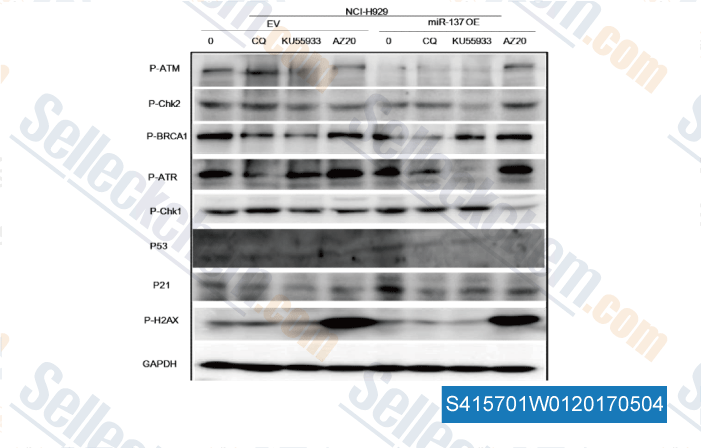
-
, , Leukemia, 2017, 31(5):1123-1135
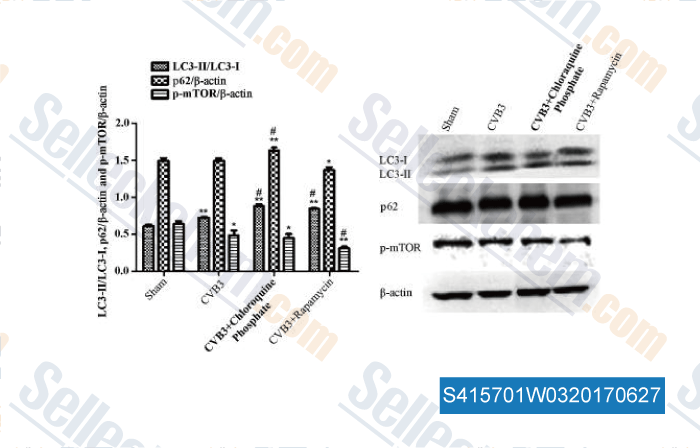
-
, , Int J Mol Med, 2017, 40(1):182-192
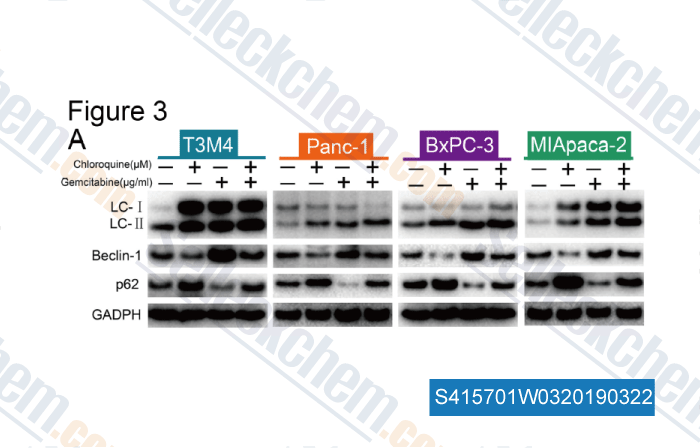
-
Gegevens van [ , , Cancer Lett, 2018, 436:129-138 ]
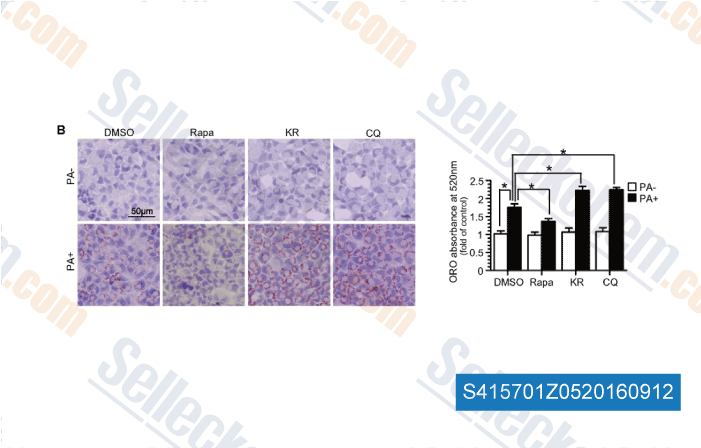
-
Gegevens van [ , , Cell Signal, 2016, 28(8):1086-98. ]
Sellecks Chloroquine diphosphate Is geciteerd door 215 Publicaties
| Melatonin ameliorates zearalenone-induced ovarian damage in mice through antioxidative effects [ Front Vet Sci, 2025, 12:1587391] | PubMed: 40860911 |
| Noncanonical function of folate through folate receptor 1 during neural tube formation [ Nat Commun, 2024, 15(1):1642] | PubMed: 38388461 |
| Macroautophagy/autophagy promotes resistance to KRASG12D-targeted therapy through glutathione synthesis [ Cancer Lett, 2024, 604:217258] | PubMed: 39276914 |
| Shaoyao-Gancao Decoction, a famous Chinese medicine formula, protects against APAP-induced liver injury by promoting autophagy/mitophagy [ Phytomedicine, 2024, 135:156053] | PubMed: 39326138 |
| KIFC1 depends on TRIM37-mediated ubiquitination of PLK4 to promote centrosome amplification in endometrial cancer [ Cell Death Discov, 2024, 10(1):419] | PubMed: 39349439 |
| Inducing Receptor Degradation as a Novel Approach to Target CC Chemokine Receptor 2 (CCR2) [ Int J Mol Sci, 2024, 25(16)8984] | PubMed: 39201670 |
| Targeting autophagy as a therapeutic strategy in pediatric acute lymphoblastic leukemia [ Sci Rep, 2024, 14(1):4000] | PubMed: 38369625 |
| A high-throughput response to the SARS-CoV-2 pandemic [ SLAS Discov, 2024, 29(5):100160] | PubMed: 38761981 |
| Lysosomes mediate the mitochondrial UPR via mTORC1-dependent ATF4 phosphorylation [ Cell Discov, 2023, 9(1):92] | PubMed: 37679337 |
| Genome homeostasis defects drive enlarged cells into senescence [ Mol Cell, 2023, 10.1016/j.molcel.2023.10.018] | PubMed: 37977116 |
RETOURBELEID
Selleck Chemicals onvoorwaardelijke retourbeleid zorgt voor een soepele online winkelervaring voor onze klanten. Als u op enigerlei wijze ontevreden bent met uw aankoop, kunt u elk artikel(en) binnen 7 dagen na ontvangst retourneren. In geval van problemen met de productkwaliteit, zowel protocolgerelateerde als productgerelateerde problemen, kunt u elk artikel(en) binnen 365 dagen na de oorspronkelijke aankoopdatum retourneren. Volg de onderstaande instructies bij het retourneren van producten.
VERZENDING EN OPSLAG
Selleck producten worden bij kamertemperatuur vervoerd. Als u het product op kamertemperatuur ontvangt, wees dan gerust, de Selleck kwaliteitsinspectieafdeling heeft experimenten uitgevoerd om te controleren of de normale temperatuurplaatsing van één maand de biologische activiteit van poederproducten niet beïnvloedt. Na ontvangst dient u het product op te slaan volgens de vereisten beschreven in het gegevensblad. De meeste Selleck producten zijn stabiel onder de aanbevolen omstandigheden.
NIET VOOR HUMANE, VETERINAIRE DIAGNOSTISCHE OF THERAPEUTISCHE DOELEINDEN.