
Technische gegevens
| Formule | C32H43N5O4 |
||||||
| Moleculair gewicht | 561.71 | CAS-nr. | 1071992-99-8 | ||||
| Oplosbaarheid (25°C)* | In vitro | DMSO | 100 mg/mL (178.02 mM) | ||||
| Ethanol | 100 mg/mL (178.02 mM) | ||||||
| Water | Insoluble | ||||||
| In vivo (Voeg oplosmiddelen afzonderlijk en in volgorde toe aan het product.) |
|
||||||
|
* <1 mg/ml betekent licht oplosbaar of onoplosbaar. * Houd er rekening mee dat Selleck de oplosbaarheid van alle verbindingen intern test en de werkelijke oplosbaarheid enigszins kan afwijken van gepubliceerde waarden. Dit is normaal en is te wijten aan lichte batch-tot-batch variaties. * Verzending op kamertemperatuur (Stabiliteitstests tonen aan dat dit product zonder koelmaatregelen kan worden verzonden.) |
|||||||
Voorbereiden van stamoplossingen
Biologische activiteit
| Beschrijving | Xevinapant (AT406, ARRY-334543, Debio1143, SM-406) is een potente Smac-mimeticum en een antagonist van IAP (remmer van Apoptosis -eiwit via E3 Ligase ), bindt aan XIAP-BIR3, cIAP1-BIR3 en cIAP2-BIR3 met een Ki van 66,4 nM, 1,9 nM en 5,1 nM, 50- tot 100-voudig hogere affiniteiten dan het Smac AVPI-peptide. Fase 1. | ||||||
|---|---|---|---|---|---|---|---|
| Doelen |
|
||||||
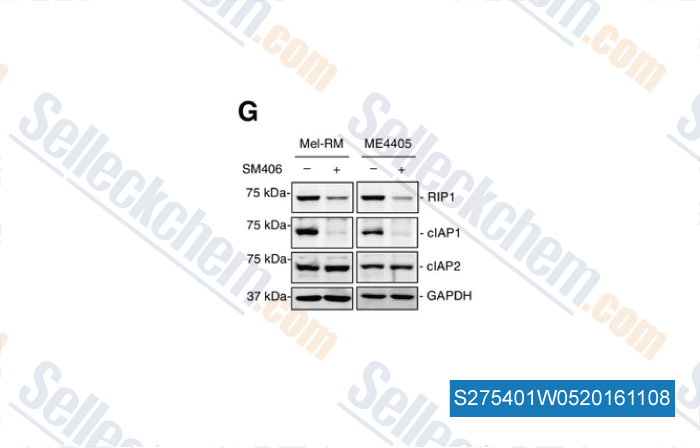
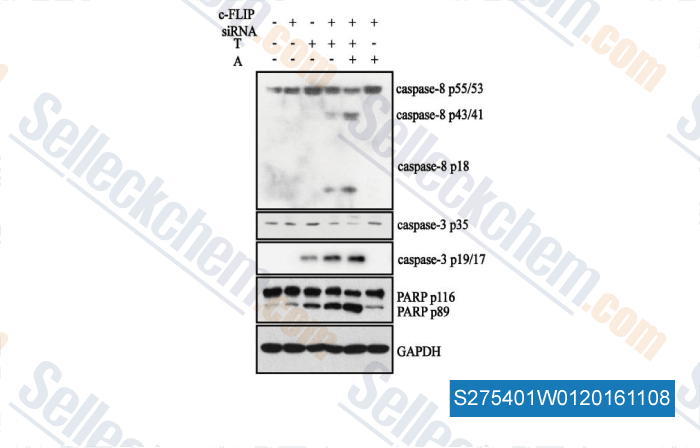
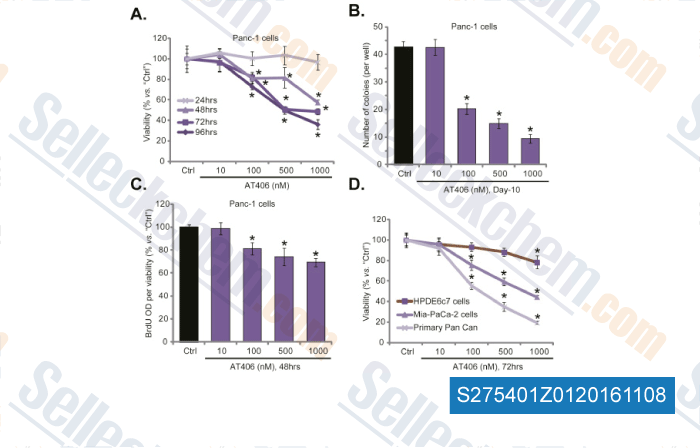
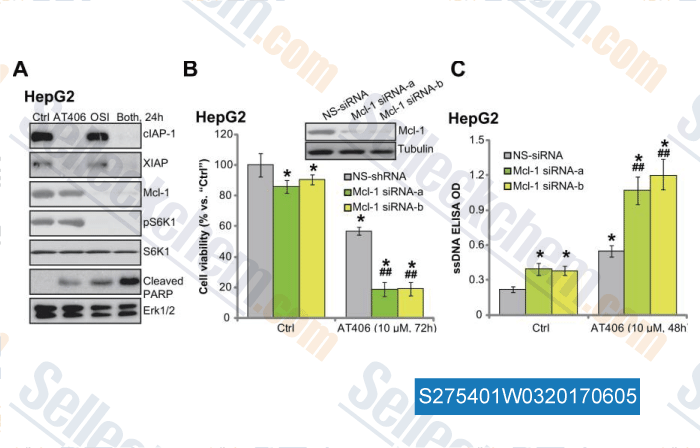
| In vitro | AT-406 is een Smac-mimeticum en lijkt het AVPI-peptide nauwkeurig na te bootsen in zowel waterstofbruggen als hydrofobe interacties met XIAP, met aanvullende hydrofobe contacten met W323 van XIAP. AT-406 is gevoeliger voor deze IAPs dan Smac AVPI-peptide met 50-100 keer hogere bindingsaffiniteiten. AT-406 (bij 1 μM) herstelt de activiteit van caspase-9, die wordt onderdrukt door 500 nM XIAP BIR3 in een celvrij systeem, volledig. In MDA-MB-231-cellen induceert AT-406 snelle cellulaire cIAP1-degradatie en trekt het ook het cellulaire XIAP-eiwit neer. AT-406 remt effectief veel menselijke kankercellijnen en toont IC50 van 144 en 142 nM in MDA-MB-231-cellen en SK-OV-3 ovariële cellen, met lage toxiciteit tegen normaal-achtige menselijke borstepitheel MCF-12F-cellen en primaire menselijke normale prostaatepitheelcellen. AT-406 induceert Apoptosis in MDA-MB-231-cellen door activering van caspase-3 en klieving van PARP te induceren. | ||||||
| In vivo | AT-406 heeft goede farmacokinetische (PK) eigenschappen en orale biologische beschikbaarheid bij muizen, ratten, niet-menselijke primaten en honden. In het MDA-MB-231-xenograft induceert AT-406 effectief cIAP1-degradatie en verwerking van procaspase-8, klieving van PARP in tumorweefsels bij 100 mg/kg met goede tolerantie, zelfs bij 200 mg/kg. AT-406 induceert een significante tumorgoei-inhibitie met een p van 0,0012 bij 100 mg/kg. |
Protocol (uit referentie)
| Kinase-assay: |
|
|---|---|
| Celassay: |
|
| Dierstudie: |
|
Referenties
|
Klantproductvalidatie
-
, , Cancer Res, 2015, 75(8):1736-48.
-
, , Int J Oncol, 2016, 49(1):153-63.
-
, , Biochem Biophys Res Commun, 2016, 478(1):293-9.
-
Gegevens van [ , , Oncotarget, 2017, 8(6):9466-9475 ]
Sellecks Xevinapant (AT406) Is geciteerd door 39 Publicaties
| Caspase 9-induced apoptosis enables efficient fetal cell ablation and disease modeling [ Nat Commun, 2025, 16(1):2572] | PubMed: 40089478 |
| The cancer-associated SF3B1K700E spliceosome mutation confers enhanced sensitivity to BV-6-induced cytotoxicity [ Cell Death Dis, 2025, 16(1):476] | PubMed: 40595498 |
| Potentiating CAR-T bystander killing by enhanced Fas/FasL signaling mitigates antigen escape in heterogeneous tumors [ bioRxiv, 2025, 2025.09.22.677496] | PubMed: 41040218 |
| Complex IIa formation and ABC transporters determine sensitivity of OSCC to Smac mimetics [ Cell Death Dis, 2024, 15(11):855] | PubMed: 39578442 |
| Combination Treatment of Resistant Acute Promyelocytic Leukemia Cells with Arsenic Trioxide and Anti-Apoptotic Gene Inhibitors [ Pharmaceuticals (Basel), 2024, 17(11)1529] | PubMed: 39598439 |
| The Effect of Xevinapant Combined with Ionizing Radiation on HNSCC and Normal Tissue Cells and the Impact of Xevinapant on Its Targeted Proteins cIAP1 and XIAP [ Cells, 2023, 12(12)1653] | PubMed: 37371123 |
| Mycoplasma hyorhinis infection promotes TNF-α signaling and SMAC mimetic-mediated apoptosis in human prostate cancer [ Heliyon, 2023, 9(10):e20655] | PubMed: 37867861 |
| CD137 (4-1BB) requires physically associated cIAPs for signal transduction and antitumor effects [ Sci Adv, 2023, 9(33):eadf6692] | PubMed: 37595047 |
| CD4+ T cell-mimicking nanoparticles encapsulating DIABLO/SMAC mimetics broadly neutralize HIV-1 and selectively kill HIV-1-infected cells [ Theranostics, 2021, 11(18):9009-9021] | PubMed: 34522224 |
| Targeting c-IAP1, c-IAP2, and Bcl-2 Eliminates Senescent Glioblastoma Cells Following Temozolomide Treatment [ Cancers (Basel), 2021, 13(14)3585] | PubMed: 34298797 |
RETOURBELEID
Selleck Chemicals onvoorwaardelijke retourbeleid zorgt voor een soepele online winkelervaring voor onze klanten. Als u op enigerlei wijze ontevreden bent met uw aankoop, kunt u elk artikel(en) binnen 7 dagen na ontvangst retourneren. In geval van problemen met de productkwaliteit, zowel protocolgerelateerde als productgerelateerde problemen, kunt u elk artikel(en) binnen 365 dagen na de oorspronkelijke aankoopdatum retourneren. Volg de onderstaande instructies bij het retourneren van producten.
VERZENDING EN OPSLAG
Selleck producten worden bij kamertemperatuur vervoerd. Als u het product op kamertemperatuur ontvangt, wees dan gerust, de Selleck kwaliteitsinspectieafdeling heeft experimenten uitgevoerd om te controleren of de normale temperatuurplaatsing van één maand de biologische activiteit van poederproducten niet beïnvloedt. Na ontvangst dient u het product op te slaan volgens de vereisten beschreven in het gegevensblad. De meeste Selleck producten zijn stabiel onder de aanbevolen omstandigheden.
NIET VOOR HUMANE, VETERINAIRE DIAGNOSTISCHE OF THERAPEUTISCHE DOELEINDEN.