
Technische gegevens
| Formule | C32H48N4O8•HCl |
||||||
| Moleculair gewicht | 653.21 | CAS-nr. | 467214-21-7 | ||||
| Oplosbaarheid (25°C)* | In vitro | DMSO | 131 mg/mL (200.54 mM) | ||||
| Water | Insoluble | ||||||
| Ethanol | Insoluble | ||||||
| In vivo (Voeg oplosmiddelen afzonderlijk en in volgorde toe aan het product.) |
|
||||||
|
* <1 mg/ml betekent licht oplosbaar of onoplosbaar. * Houd er rekening mee dat Selleck de oplosbaarheid van alle verbindingen intern test en de werkelijke oplosbaarheid enigszins kan afwijken van gepubliceerde waarden. Dit is normaal en is te wijten aan lichte batch-tot-batch variaties. * Verzending op kamertemperatuur (Stabiliteitstests tonen aan dat dit product zonder koelmaatregelen kan worden verzonden.) |
|||||||
Voorbereiden van stamoplossingen
Biologische activiteit
| Beschrijving | Alvespimycin (17-DMAG, NSC 707545, BMS 826476, KOS 1022) HCl is een potente HSP90-remmer met een IC50 van 62 nM in een celvrije test. | ||
|---|---|---|---|
| Doelen |
|
||
| In vitro | 17-DMAG vertoont een ongeveer 2 keer hogere potentie tegen menselijke Hsp90 dan 17-AAG, met een IC50 van 62 nM versus 119 nM. In SKBR3- en SKOV3-cellen die Hsp90-cliëntproteïne Her2 overexpressie vertonen, veroorzaakt 17-DMAG een downregulatie van Her2 met EC50 van respectievelijk 8 nM en 46 nM, evenals inductie van Hsp70 met EC50 van respectievelijk 4 nM en 14 nM, leidend tot significante cytotoxiciteit met GI50 van respectievelijk 29 nM en 32 nM, consistent met Hsp90-remming. 17-DMAG in combinatie met vorinostat induceert synergetisch apoptose van de gekweekte MCL-cellen en primaire MCL-cellen, potenter dan elk middel afzonderlijk, door de niveaus van cycline D1 en CDK4, evenals c-Myc, c-RAF en Akt, aanzienlijk te verzwakken. In tegenstelling tot 17-AAG dat alleen actief is voor IKKβ in chronische lymfocytische leukemie (CLL) cellen, leidt 17-DMAG behandeling effectief tot uitputting van het Hsp90-cliëntproteïne, resulterend in verminderde NF-κB p50/p65 DNA-binding, verminderde NF-κB targetgen transcriptie en caspase-afhankelijke apoptose. Door de NF-κB-familie te targeten, medieert 17-DMAG selectief dosis- en tijdsafhankelijke cytotoxiciteit tegen CLL-cellen, maar niet tegen normale T-cellen of NK-cellen die belangrijk zijn voor immuunbewaking. |
||
| In vivo | 17-DMAG-behandeling met 5 mg/kg of 25 mg/kg driemaal per week vermindert de tumorgroei van TMK-1-xenografts significant, door het vaatgebied en het aantal prolifererende tumorcellen in coupes significant te verminderen. Consistent met de remming van FAK-signalering in vivo, onderdrukt 17-DMAG-behandeling met 25 mg/kg driemaal per week de tumorgroei en metastase van ME180- en SiHa-xenografts bij muizen significant. Toediening van 17-DMAG met 10 mg/kg gedurende 16 dagen vermindert het aantal witte bloedcellen significant en verlengt de overleving in een TCL1-SCID-transplantatiemuismodel. |
||
| Kenmerken | Een synthetisch derivaat van Geldanamycine, met een lagere hepatotoxiciteit dan het ouderantibioticum en hogere potentie en biologische beschikbaarheid dan het vergelijkbare derivaat 17-AAG. |
Protocol (uit referentie)
| Kinase-assay: |
|
|---|---|
| Celassay: |
|
| Dierstudie: |
|
Referenties
|
Klantproductvalidatie
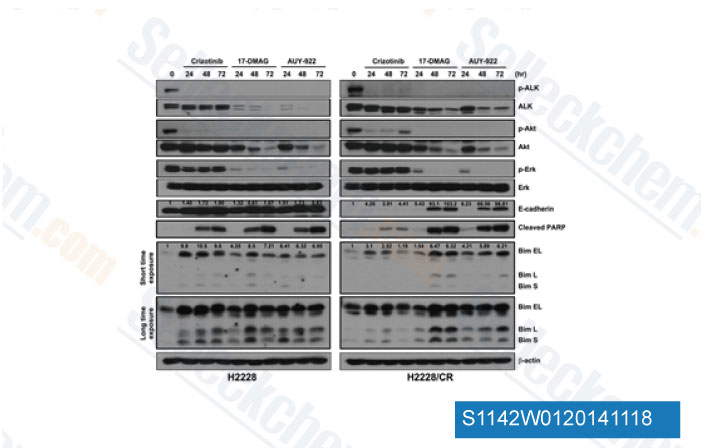
-
Gegevens van [ Mol Oncol , 2013 , 7(6), 1093-102 ]
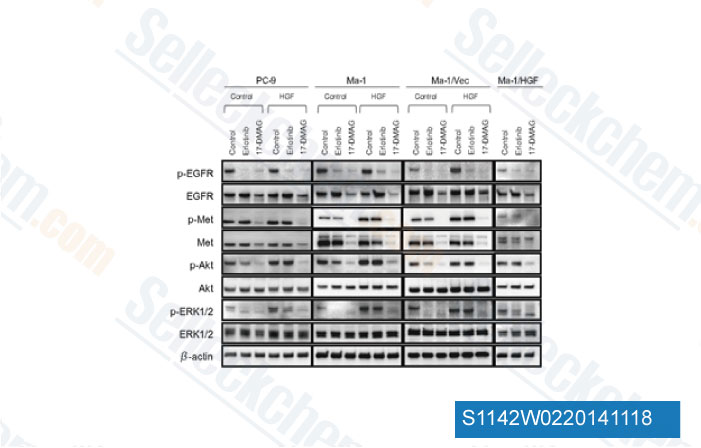
-
Gegevens van [ J Thorac Oncol , 2012 , 7(7), 1078-85 ]

-
Gegevens van [ J Thorac Oncol , 2012 , 7(7), 1078-85 ]
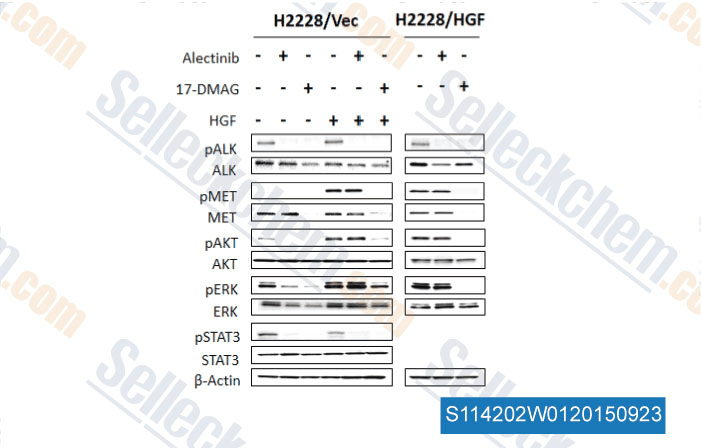
-
Gegevens van [ , , Oncotarget, 2014, 5(13): 4920-28 ]
Sellecks Alvespimycin (17-DMAG) Hydrochloride Is geciteerd door 72 Publicaties
| CD19-targeted HSP90 inhibitor nanoparticle combined with TKIs reduces tumor burden and enhances T-cell immunity in murine B-cell malignancies [ Theranostics, 2025, 15(8):3589-3609] | PubMed: 40093890 |
| Pharmacological Modulation of the Unfolded Protein Response as a Therapeutic Approach in Cutaneous T-Cell Lymphoma [ Biomolecules, 2025, 15(1)76] | PubMed: 39858470 |
| ETS1 Orchestrates a Hybrid EMT Program Driving in vivo Metastasis and Immune Evasion [ bioRxiv, 2025, 2025.07.17.665404] | PubMed: 40777467 |
| Stress response silencing by an E3 ligase mutated in neurodegeneration [ Nature, 2024, 626(8000):874-880] | PubMed: 38297121 |
| Pan-cancer proteogenomics expands the landscape of therapeutic targets [ Cell, 2024, S0092-8674(24)00583-X] | PubMed: 38917788 |
| Cytokine-Induced Killer Cells in Combination with Heat Shock Protein 90 Inhibitors Functioning via the Fas/FasL Axis Provides Rationale for a Potential Clinical Benefit in Burkitt's lymphoma [ Int J Mol Sci, 2023, 24(15)12476] | PubMed: 37569852 |
| Role of heat shock protein 90 as an antiviral target for swine enteric coronaviruses [ Virus Res, 2023, 329:199103] | PubMed: 36963723 |
| Heat shock protein 90 facilitates SARS-CoV-2 structural protein-mediated virion assembly and promotes virus-induced pyroptosis [ J Biol Chem, 2023, 299(5):104668] | PubMed: 37011862 |
| Alvespimycin Inhibits Heat Shock Protein 90 and Overcomes Imatinib Resistance in Chronic Myeloid Leukemia Cell Lines [ Molecules, 2023, 28(3)1210] | PubMed: 36770876 |
| Local Elimination of Senescent Cells Promotes Bone Defect Repair during Aging [ ACS Appl Mater Interfaces, 2022, 10.1021/acsami.1c22138] | PubMed: 35014784 |
RETOURBELEID
Selleck Chemicals onvoorwaardelijke retourbeleid zorgt voor een soepele online winkelervaring voor onze klanten. Als u op enigerlei wijze ontevreden bent met uw aankoop, kunt u elk artikel(en) binnen 7 dagen na ontvangst retourneren. In geval van problemen met de productkwaliteit, zowel protocolgerelateerde als productgerelateerde problemen, kunt u elk artikel(en) binnen 365 dagen na de oorspronkelijke aankoopdatum retourneren. Volg de onderstaande instructies bij het retourneren van producten.
VERZENDING EN OPSLAG
Selleck producten worden bij kamertemperatuur vervoerd. Als u het product op kamertemperatuur ontvangt, wees dan gerust, de Selleck kwaliteitsinspectieafdeling heeft experimenten uitgevoerd om te controleren of de normale temperatuurplaatsing van één maand de biologische activiteit van poederproducten niet beïnvloedt. Na ontvangst dient u het product op te slaan volgens de vereisten beschreven in het gegevensblad. De meeste Selleck producten zijn stabiel onder de aanbevolen omstandigheden.
NIET VOOR HUMANE, VETERINAIRE DIAGNOSTISCHE OF THERAPEUTISCHE DOELEINDEN.