OSI-930

CatalogusnummerS1220 Batch:S122001

Afdrukken

Technische gegevens

Formule

C22H16F3N3O2S

Moleculair gewicht 443.44 CAS-nr. 728033-96-3
Oplosbaarheid (25°C)* In vitro DMSO 89 mg/mL (200.7 mM)
Ethanol 3 mg/mL (6.76 mM)
Water Insoluble
In vivo (Voeg oplosmiddelen afzonderlijk en in volgorde toe aan het product.)
Homogeneous suspension
CMC-NA
≥5mg/ml Taking the 1 mL working solution as an example, add 5 mg of this product to 1 ml of CMC-Na solution, mix evenly to obtain a homogeneous suspension with a final concentration of 5 mg/ml.
* <1 mg/ml betekent licht oplosbaar of onoplosbaar.
* Houd er rekening mee dat Selleck de oplosbaarheid van alle verbindingen intern test en de werkelijke oplosbaarheid enigszins kan afwijken van gepubliceerde waarden. Dit is normaal en is te wijten aan lichte batch-tot-batch variaties.
* Verzending op kamertemperatuur (Stabiliteitstests tonen aan dat dit product zonder koelmaatregelen kan worden verzonden.)

Voorbereiden van stamoplossingen

Biologische activiteit

Beschrijving OSI-930 is een krachtige remmer van Kit (c-Kit), KDR en CSF-1R met respectievelijk een IC50 van 80 nM, 9 nM en 15 nM; deze verbinding is ook krachtig tegen Flt-1, c-Raf en Lck en heeft een lage activiteit tegen PDGFRα/β, Flt-3 en Abl. Fase 1.
Doelen
FLT1
(Cell-free assay)
KDR
(Cell-free assay)
CSF-1R
(Cell-free assay)
LCK
(Cell-free assay)
C-Raf
(Cell-free assay)
Meer bekijken
8 nM 9 nM 15 nM 22 nM 41 nM
In vitro OSI-930 remt de celproliferatie in de HMC-1 cellijn met een IC50 van 14 nM zonder significant effect op de groei van de COLO-205 cellijn die geen constitutief actieve mutante receptor tyrosine kinase tot expressie brengt. Bovendien induceert deze verbinding ook apoptose in de HMC-1 cellijn met een EC50 van 34 nM. Een recente studie toont aan dat deze chemische stof gezuiverd, recombinant cytochroom P450 (P450) 3A4 inactiveert met een Ki van 24 μM op een tijd- en concentratieafhankelijke manier.
In vivo OSI-930, toegediend in de maximaal werkzame dosis van 200 mg/kg via orale gavage, vertoont krachtige antitumoractiviteit in een breed scala aan preklinische xenograftmodellen, waaronder HMC-1, NCI-SNU-5, COLO-205 en U251 xenograftmodellen.

Protocol (uit referentie)

Kinase-assay:[1]
  • Proteïnekinase-assays

    Proteïnekinase-assays worden intern uitgevoerd met behulp van ELISA-gebaseerde assaymethoden (Kit, KDR, PDGFRα en PDGFRβ) of met een radiometrische methode. Interne ELISA-assays gebruikten poly(Glu:Tyr) als substraat gebonden aan het oppervlak van 96-wells assayplaten; fosforylering wordt vervolgens gedetecteerd met behulp van een antifosfotyrosine-antilichaam geconjugeerd aan HRP. Het gebonden antilichaam wordt vervolgens gekwantificeerd met behulp van ABTS als het peroxidase-substraat door de absorptie bij 405/490 nm te meten. Alle assays gebruiken gezuiverde recombinante kinase-katalytische domeinen die worden uitgedrukt in insectencellen of in bacteriën. Het Kit- en EGFR-eiwit dat wordt gebruikt voor interne assays wordt intern bereid; andere enzymen worden verkregen. Recombinant Kit-eiwit wordt uitgedrukt als een NH2-terminaal glutathion S-transferase fusie-eiwit in insectencellen en wordt aanvankelijk gezuiverd als een niet-gefosforyleerd (niet-geactiveerd) enzym met een relatief hoge Km voor ATP (400 μM). In sommige assays wordt een geactiveerde (tyrosine-gefosforyleerde) vorm van het enzym bereid door incubatie met 1 mM ATP gedurende 1 uur bij 30 °C. Het gefosforyleerde eiwit wordt vervolgens door een ontzoutingskolom geleid om het grootste deel van het ATP te verwijderen en opgeslagen bij -80 °C in buffer die 50% glycerol bevat. De resulterende bereiding heeft een aanzienlijk hogere specifieke activiteit en een lagere Km voor ATP (25 μM) dan de initiële niet-gefosforyleerde bereiding. De remming van Kit-autofosforylering door deze verbinding wordt geanalyseerd door incubatie van het niet-gefosforyleerde enzym bij 30 °C in aanwezigheid van 200 μM ATP en verschillende concentraties van deze chemische stof. De reactie wordt gestopt door aliquotten te verwijderen in SDS-PAGE sample buffer, gevolgd door verwarming tot 100 °C gedurende 5 minuten. De mate van fosforylering van Kit wordt vervolgens bepaald door immunoblotting voor zowel totale Kit als gefosforyleerde Kit.

Celassay:[1]
  • Cellijnen

    HMC-1 and COLO-205

  • Concentraties

    0--1 μM

  • Incubatietijd

    48 hours

  • Methode

    For assays of cell proliferation and apoptosis, cells are seeded into 96-well plates and incubated for 2 to 3 days in the presence of OSI-930 at various concentrations. Inhibition of cell growth is determined by luminescent quantitation of the intracellular ATP content using CellTiterGlo. Induction of caspase-dependent apoptosis by this compound is quantitated by an enzymatic caspase 3/7 assay. Inhibition of angiogenesis by this chemical is monitored using the rat aortic ring endothelial sprout outgrowth assay. Sections of aorta are prepared from CO2-euthanized male rats and cultured in vitro in a collagen matrix in the presence or absence of this compound. The collagen matrix is prepared from type 1 rat tail collagen solubilized in 0.1% acetic acid at 3 mg/mL, which is combined with 0.125 volume collagen buffer (0.05 N NaOH, 200 mM HEPES, 260 mM NaHCO3), 0.125 volume of medium 199, 0.0125 volume of 1 M NaOH, and 1% GlutaMax. Aortic rings are embedded in 0.4 mL of this matrix in six-well plates, to which 0.5 mL endothelial basal medium and the appropriate amount of this chemical is added; the rings are then incubated for 10 days and the resultant angiogenic sprout outgrowth is digitally quantitated from images by measurement of the sprout-containing area within a series of concentric rings around the aortic tissue area.

Dierstudie:[1]
  • Dierlijke modellen

    HMC-1, NCI-SNU-5, COLO-205 and U251 cells are injected s.c. into the right flank of CD1 nu/nu mice.

  • Doseringen

    ≤200 mg/kg

  • Toediening

    Administered via p.o.

Referenties

  • https://pubmed.ncbi.nlm.nih.gov/16424037/
  • https://pubmed.ncbi.nlm.nih.gov/21068193/

Klantproductvalidatie

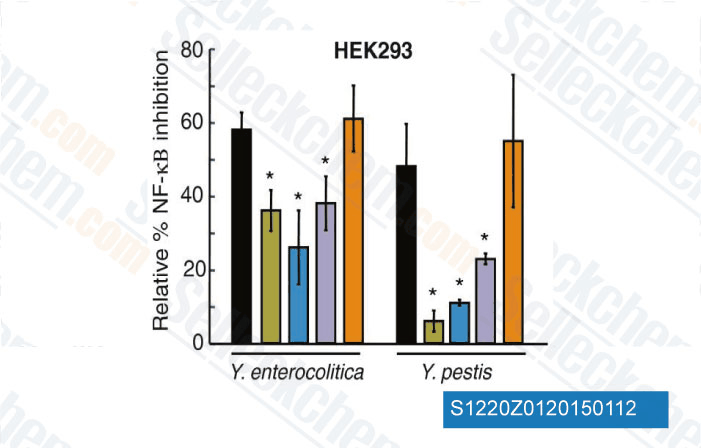
RE-luc2P-HEK293 cells were pretreated with 1uM OSI-930 (green), 20uM TBB (blue), 10uM CKI-7 (purple), or 10uM H-89 (orange) for 16 h and infected with Y. enterocolitica WA or Y. pestis Ind195 at MOI 1 and 20, respectively, for 1 h. Following stimulation with 10 ng/ml TNF-α at 5 h post-infection, luciferase activity was measured 24 h post-infection. Results were determined from two independent experiments performed in triplicate. A"*" denotes that the % NF-κβ inhibition using the inhibitors was significantly different (p<0.05) compared to the no drug control (black). The relative NF-κB inhibition by Yersinia infection was determined as a percentage of luciferase activity in bacteria-infected cells relative to luciferase activity in bacteria-free control cells.

Gegevens van [ BMC Microbiol , 2013 , 13, 249 ]
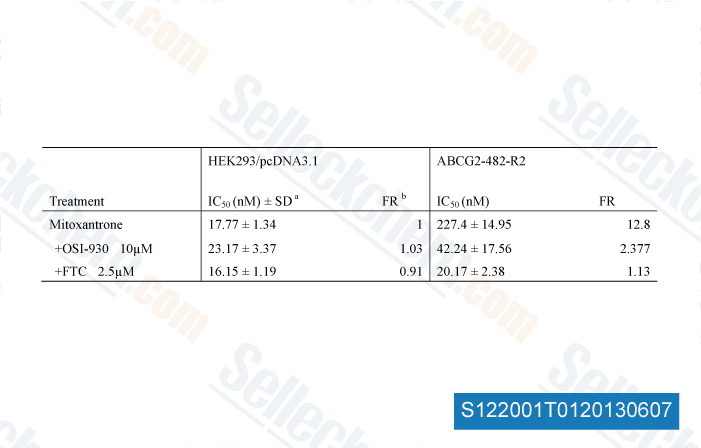
<p> </p><p>Table 2. shows the reversal effect of OSI-930 and Fumitremorgin C (FTC) on the cytotoxicity of mitoxantrone to HEK293/pcDNA3.1 and HEK293-ABCG2-482-R2.<sup>a</sup>IC<sub>50</sub>: concentration that inhibited cell survival by 50% (means ± SD). <sup>b</sup>FR: fold-resistance was the value of that IC<sub>50</sub> value for mitoxantrone of HEK293/pcDNA3.1 cells was divided by IC<sub>50</sub> value for mitoxantrone of HEK293/pcDNA3.1 and HEK293-ABCG2-482-R2 cells in the absence or presence of OSI-930 and Fumitremorgin C (FTC). Values in table are representative of at least three independent experiments performed in triplicate.</p>

,

<p>For MTT assays, cells (2,000 ~ 5,000 cells/well) were subcultured into 96-well plates according to their growth properties. Cell proliferation was assayed at 72 hr after treatment of OSI-930 by adding 20 μl of 5 mg/ml 3-(4,5-Dimethylthiazol-2-yl)-2,5-diphenyltetrazolium bromide (MTT) solution per 100 μl of growth medium. After incubating for 3-4 h at 37°C, the media were removed and 150 µl/well of MTT solvent (either absolute DMSO or isopropanol containing 4 mM HCl and 0.1% Nonidet-40) was added to dissolve the formazan</p>

, , Dr. Yong-Weon Yi from Georgetown University Medical Center

Sellecks OSI-930 Is geciteerd door 7 Publicaties

Orthogonal proteogenomic analysis identifies the druggable PA2G4-MYC axis in 3q26 AML [ Nat Commun, 2024, 15(1):4739] PubMed: 38834613
Small-Molecule and CRISPR Screening Converge to Reveal Receptor Tyrosine Kinase Dependencies in Pediatric Rhabdoid Tumors. [ Cell Rep, 2019, 28(9):2331-2344] PubMed: 31461650
TLR7/8-agonist-loaded Nanoparticles Promote the Polarization of Tumour-Associated Macrophages to Enhance Cancer Immunotherapy [ Nat Biomed Eng, 2018, 2(8):578-588] PubMed: 31015631
Targeting a cell state common to triple-negative breast cancers [Muellner MK, et al. Mol Syst Biol, 2015, 11(1):789] PubMed: 25699542
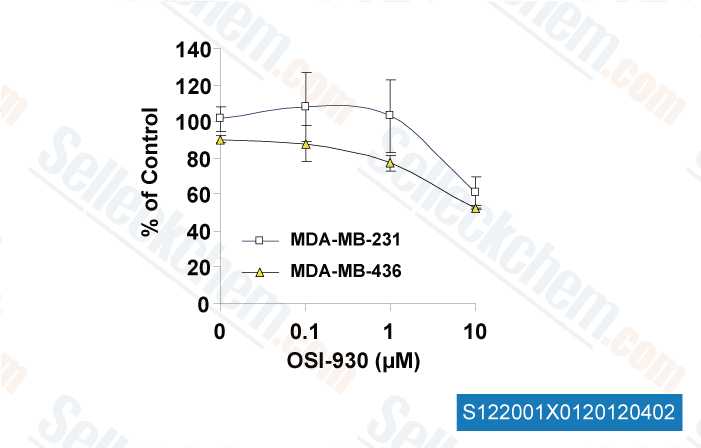
Dual inhibition of EGFR and MET induces synthetic lethality in triple-negative breast cancer cells through downregulation of ribosomal protein S6. [Yi YW, et al. Int J Oncol, 2015, 47(1):122-32] PubMed: 25955731
c-KIT signaling is targeted by pathogenic Yersinia to suppress the host immune response. [Micheva-Viteva SN, et al. BMC Microbiol, 2013, 13(1):249] PubMed: 24206648
OSI-930 analogues as novel reversal agents for ABCG2-mediated multidrug resistance. [Kuang Y, et al. Biochem Pharmacol, 2012, 84(6):766-74] PubMed: 22750060

RETOURBELEID
Selleck Chemicals onvoorwaardelijke retourbeleid zorgt voor een soepele online winkelervaring voor onze klanten. Als u op enigerlei wijze ontevreden bent met uw aankoop, kunt u elk artikel(en) binnen 7 dagen na ontvangst retourneren. In geval van problemen met de productkwaliteit, zowel protocolgerelateerde als productgerelateerde problemen, kunt u elk artikel(en) binnen 365 dagen na de oorspronkelijke aankoopdatum retourneren. Volg de onderstaande instructies bij het retourneren van producten.

VERZENDING EN OPSLAG
Selleck producten worden bij kamertemperatuur vervoerd. Als u het product op kamertemperatuur ontvangt, wees dan gerust, de Selleck kwaliteitsinspectieafdeling heeft experimenten uitgevoerd om te controleren of de normale temperatuurplaatsing van één maand de biologische activiteit van poederproducten niet beïnvloedt. Na ontvangst dient u het product op te slaan volgens de vereisten beschreven in het gegevensblad. De meeste Selleck producten zijn stabiel onder de aanbevolen omstandigheden.

NIET VOOR HUMANE, VETERINAIRE DIAGNOSTISCHE OF THERAPEUTISCHE DOELEINDEN.