
Technische gegevens
| Formule | C21H27N7O3 |
||||||
| Moleculair gewicht | 425.48 | CAS-nr. | 937174-76-0 | ||||
| Oplosbaarheid (25°C)* | In vitro | DMSO | 21 mg/mL (49.35 mM) | ||||
| Water | Insoluble | ||||||
| Ethanol | Insoluble | ||||||
| In vivo (Voeg oplosmiddelen afzonderlijk en in volgorde toe aan het product.) |
|
||||||
|
* <1 mg/ml betekent licht oplosbaar of onoplosbaar. * Houd er rekening mee dat Selleck de oplosbaarheid van alle verbindingen intern test en de werkelijke oplosbaarheid enigszins kan afwijken van gepubliceerde waarden. Dit is normaal en is te wijten aan lichte batch-tot-batch variaties. * Verzending op kamertemperatuur (Stabiliteitstests tonen aan dat dit product zonder koelmaatregelen kan worden verzonden.) |
|||||||
Voorbereiden van stamoplossingen
Biologische activiteit
| Beschrijving | GSK690693 is een pan-Akt-remmer die Akt1/2/3 target met een IC50 van 2 nM/13 nM/9 nM in celvrije assays, en is ook gevoelig voor de AGC-kinasefamilie: PKA, PrkX en PKC-isozymen. GSK690693 remt ook krachtig AMPK en DAPK3 uit de CAMK-familie met een IC50 van respectievelijk 50 nM en 81 nM. GSK690693 beïnvloedt de activiteit van Unc-51-like autofagie-activerende kinase 1 (ULK1), remt robuust de STING-afhankelijke IRF3-activering. Fase 1. | |||||||||||
|---|---|---|---|---|---|---|---|---|---|---|---|---|
| Doelen |
|
|||||||||||
| In vitro | GSK690693 is zeer selectief voor de Akt-isoformen ten opzichte van de meeste kinasen in andere families. Dit compound is echter minder selectief voor leden van de AGC-kinasefamilie, waaronder PKA, PrkX en PKC-isozymen, met een IC50 van respectievelijk 24 nM, 5 nM en 2-21 nM. Het remt ook krachtig AMPK en DAPK3 uit de CAMK-familie met een IC50 van respectievelijk 50 nM en 81 nM, en PAK4, 5 en 6 uit de STE-familie met een IC50 van respectievelijk 10 nM, 52 nM en 6 nM. Deze chemische stof remt de fosforylering van GSK3β in tumorcellen met een IC50 variërend van 43 nM tot 150 nM. De behandeling leidt tot een dosisafhankelijke toename van de nucleaire accumulatie van de transcriptiefactor FOXO3A. Dit compound remt krachtig de proliferatie van T47D-, ZR-75-1-, BT474-, HCC1954-, MDA-MB-453- en LNCaP-cellen met een IC50 van respectievelijk 72 nM, 79 nM, 86 nM, 119 nM, 975 nM en 147 nM. De behandeling induceert apoptose bij concentraties >100 nM in zowel LNCaP- als BT474-cellen. In overeenstemming met de rol van AKT in celoverleving, induceert het apoptose in gevoelige ALL-cellijnen. |
|||||||||||
| In vivo | Een enkele toediening van GSK690693 remt GSK3β-fosforylering in humane borstcarcinoom (BT474) xenografts op een dosis- en tijdsafhankelijke manier. Evenzo induceert dit compound een vermindering van de fosforylering van de Akt-substraten, PRAS40 en FKHR/FKHRL1. Het resulteert ook in een acute toename van de bloedglucose, die 8 tot 10 uur na medicijntoediening terugkeert naar de basislijn. Toediening van deze chemische stof induceert verminderingen in gefosforyleerde Akt-substraten in vivo en remt krachtig de groei van humane SKOV-3 ovarium-, LNCaP prostaat- en BT474- en HCC-1954 borstcarcinoom xenografts, met een maximale remming van 58% tot 75% bij een dosis van 30 mg/kg/dag. Dit compound vertoont werkzaamheid, ongeacht het betrokken mechanisme van Akt-activering. Het is het meest effectief in het vertragen van tumorprogressie bij Lck-MyrAkt2-muizen die een membraangebonden, constitutief actieve vorm van Akt tot expressie brengen. |
Protocol (uit referentie)
| Kinase-assay: |
|
|---|---|
| Celassay: |
|
| Dierstudie: |
|
Referenties
|
Klantproductvalidatie
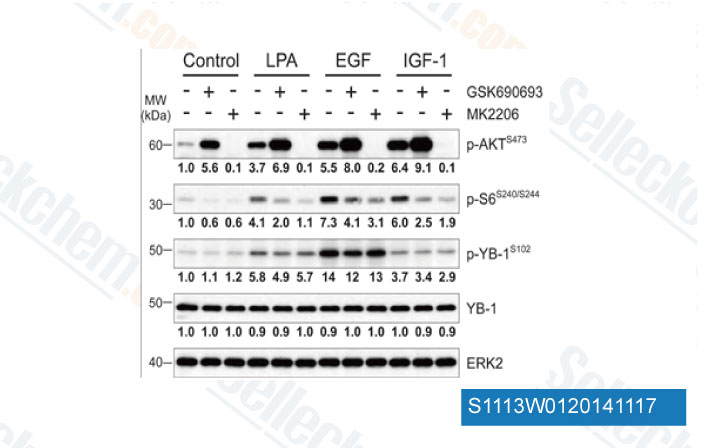
-
Gegevens van [ Oncogene , 2014 , 33(22), 2846-56 ]
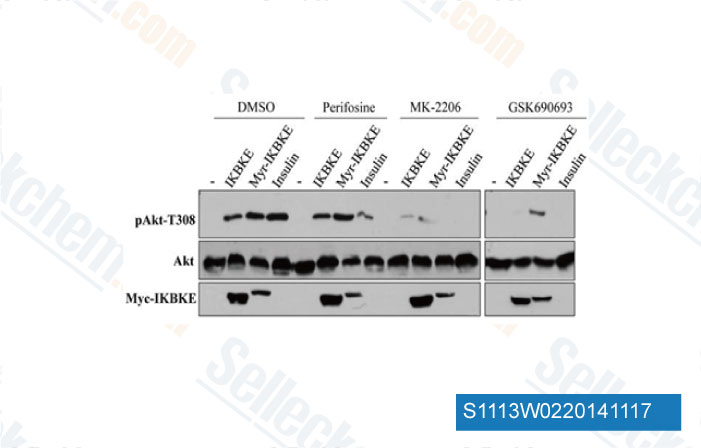
-
Gegevens van [ J Biol Chem , 2011 , 286(43), 37389-98 ]
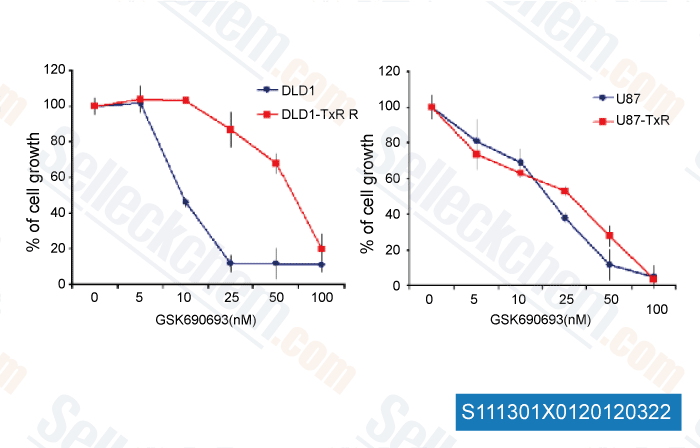
-
, , Dr. Milica Pesic of Institute for Biological Research
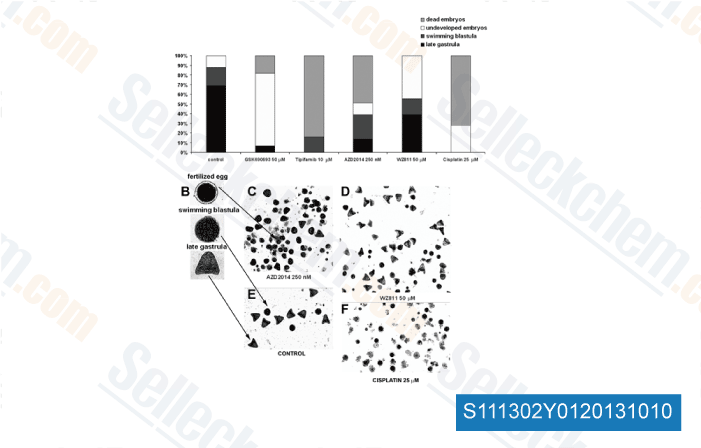
-
, , Dr. Milica Pesic from Institute for Biological Research
Sellecks GSK690693 Is geciteerd door 127 Publicaties
| Endothelial cell-derived SDF-1α elicits stemness traits of glioblastoma via dual-regulation of GLI1 [ Theranostics, 2025, 15(18):9819-9837] | PubMed: 41041071 |
| High fructose promotes MYCN-amplified neuroblastoma progression through NgBR-ACSS2-mediated biosynthesis of acetyl-CoA [ Cell Rep, 2025, 44(7):115947] | PubMed: 40616844 |
| Staphylococcus aureus utilizes vimentin to internalize human keratinocytes [ Front Cell Infect Microbiol, 2025, 15:1543186] | PubMed: 40061451 |
| Low-Dose Perifosine, a Phase II Phospholipid Akt Inhibitor, Selectively Sensitizes Drug-Resistant ABCB1-Overexpressing Cancer Cells [ Biomol Ther (Seoul), 2025, 33(1):170-181] | PubMed: 39632683 |
| TBK1-Zyxin signaling controls tumor-associated macrophage recruitment to mitigate antitumor immunity [ EMBO J, 2024, 10.1038/s44318-024-00244-9] | PubMed: 39304793 |
| RIG-I is an intracellular checkpoint that limits CD8+ T-cell antitumour immunity [ EMBO Mol Med, 2024, 10.1038/s44321-024-00136-9] | PubMed: 39322862 |
| RIG-I is an intracellular checkpoint that limits CD8+ T-cell antitumor immunity [ EMBO Mol Med, 2024, 16: 3005 - 3025] | PubMed: None |
| Hyperglycemia-induced Sirt3 downregulation increases microglial aerobic glycolysis and inflammation in diabetic neuropathic pain pathogenesis [ CNS Neurosci Ther, 2024, 30(8):e14913] | PubMed: 39123294 |
| TMEM176B Promotes EMT via FGFR/JNK Signalling in Development and Tumourigenesis of Lung Adenocarcinoma [ Cancers (Basel), 2024, 16(13)2447] | PubMed: 39001509 |
| Kinase inhibitor pulldown assay (KiP) for clinical proteomics [ Clin Proteomics, 2024, 21(1):3] | PubMed: 38225548 |
RETOURBELEID
Selleck Chemicals onvoorwaardelijke retourbeleid zorgt voor een soepele online winkelervaring voor onze klanten. Als u op enigerlei wijze ontevreden bent met uw aankoop, kunt u elk artikel(en) binnen 7 dagen na ontvangst retourneren. In geval van problemen met de productkwaliteit, zowel protocolgerelateerde als productgerelateerde problemen, kunt u elk artikel(en) binnen 365 dagen na de oorspronkelijke aankoopdatum retourneren. Volg de onderstaande instructies bij het retourneren van producten.
VERZENDING EN OPSLAG
Selleck producten worden bij kamertemperatuur vervoerd. Als u het product op kamertemperatuur ontvangt, wees dan gerust, de Selleck kwaliteitsinspectieafdeling heeft experimenten uitgevoerd om te controleren of de normale temperatuurplaatsing van één maand de biologische activiteit van poederproducten niet beïnvloedt. Na ontvangst dient u het product op te slaan volgens de vereisten beschreven in het gegevensblad. De meeste Selleck producten zijn stabiel onder de aanbevolen omstandigheden.
NIET VOOR HUMANE, VETERINAIRE DIAGNOSTISCHE OF THERAPEUTISCHE DOELEINDEN.