
alleen voor onderzoeksdoeleinden
Zinc Pyrithione Proton Pump Remmer
Cat.nr.: S4075
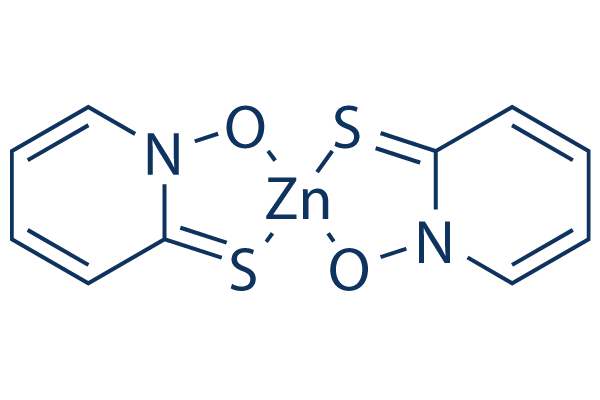
Chemische structuur
Molecuulgewicht: 317.7
Kwaliteitscontrole (Quality Control)
| Gerelateerde doelwitten | CFTR CRM1 CD markers AChR Calcium Channel Sodium Channel Potassium Channel GABA Receptor TRP Channel ATPase |
|---|---|
| Overig Proton Pump Inhibitoren | Bafilomycin A1 (Baf-A1) Ilaprazole Tenatoprazole Revaprazan Hydrochloride Ilaprazole sodium PF-3716556 Ufiprazole PAβN dihydrochloride |
Chemische informatie, opslag en stabiliteit (Chemical Information, Storage & Stability)
| Molecuulgewicht | 317.7 | Formule | C10H8N2O2S2Zn |
Opslag (vanaf de datum van ontvangst) | |
|---|---|---|---|---|---|
| CAS-nr. | 13463-41-7 | SDF downloaden | Opslag van stamoplossingen |
|
|
| Synoniemen | OM-1563 | Smiles | C1=CC=[N+](C(=C1)[S-])[O-].C1=CC=[N+](C(=C1)[S-])[O-].[Zn+2] | ||
Oplosbaarheid (Solubility)
|
In vitro |
DMSO
: 30 mg/mL
(94.42 mM)
Water : Insoluble Ethanol : Insoluble |
Molariteitscalculator
|
In vivo |
|||||
In vivo formulatiecalculator (heldere oplossing)
Stap 1: Voer onderstaande informatie in (Aanbevolen: een extra dier om rekening te houden met verlies tijdens het experiment)
Stap 2: Voer de in vivo formulering in (Dit is alleen de calculator, geen formulering. Neem eerst contact met ons op als er geen in vivo formulering is in de sectie oplosbaarheid.)
Berekeningsresultaten:
Werkconcentratie: mg/ml;
Methode voor het bereiden van DMSO-moedervloeistof: mg geneesmiddel vooropgelost in μL DMSO ( Concentratie moedervloeistof mg/mL, Neem eerst contact met ons op als de concentratie de DMSO-oplosbaarheid van de batch van het geneesmiddel overschrijdt. )
Methode voor het bereiden van in vivo formulering: Neem μL DMSO moedervloeistof, voeg daarna toeμL PEG300, mengen en verhelderen, daarna toevoegenμL Tween 80, mengen en verhelderen, daarna toevoegen μL ddH2O, mengen en verhelderen.
Methode voor het bereiden van in vivo formulering: Neem μL DMSO moedervloeistof, voeg daarna toe μL Maïsolie, mengen en verhelderen.
Opmerking: 1. Zorg ervoor dat de vloeistof helder is voordat u het volgende oplosmiddel toevoegt.
2. Zorg ervoor dat u het/de oplosmiddel(en) in de juiste volgorde toevoegt. U moet ervoor zorgen dat de verkregen oplossing, bij de vorige toevoeging, een heldere oplossing is voordat u verdergaat met het toevoegen van het volgende oplosmiddel. Fysieke methoden zoals vortexen, ultrasoon of een warmwaterbad kunnen worden gebruikt om het oplossen te bevorderen.
Werkingsmechanisme (Mechanism of Action)
| Targets/IC50/Ki |
Proton pump
|
|---|---|
| In vitro |
Zinc pyrithione is considered as a coordination complex of zinc. The pyrithione ligands, which are formally monoanions, are chelated to Zn 2+ via oxygen and sulfur centers. In the crystalline state, zinc pyrithione exists as a centrosymmetric dimer, where each zinc is bonded to two sulfur and three oxygen centers. In solution, however, the dimers dissociate via scission of one Zn-O bond. Zinc pyrithione, which is a dimer but is probably biologically active as a monomer, induces plasma membrane depolarization with half-maximal effect (K1/2) of about 0.3 mM. Zinc pyrithione is an unusual synthetic potentiator that potently activates both heterologous and native M channels by inducing channel opening at the resting potential.
|
| In vivo |
Zinc pyrithione rapidly accumulated in the tissues of the exposed mussels, proportionately to both exposure concentration and time. Even though the 7-d median lethal concentration (LC50) = 8.27 μM established here appears high with respect to reported ZnPT environmental concentrations, the results indicate that this biocide could represent a threat for marine organisms in coastal environments and that further investigations on its biological effects at sublethal doses are needed.
|
Referenties |
|

Producten zijn uitsluitend voor onderzoeksdoeleinden. Niet voor menselijk gebruik. Wij verkopen niet aan patiënten.
©Copyright 2013 Selleck Chemicals. Alle rechten voorbehouden.