
alleen voor onderzoeksdoeleinden
Vincamine
Cat.nr.: S3891
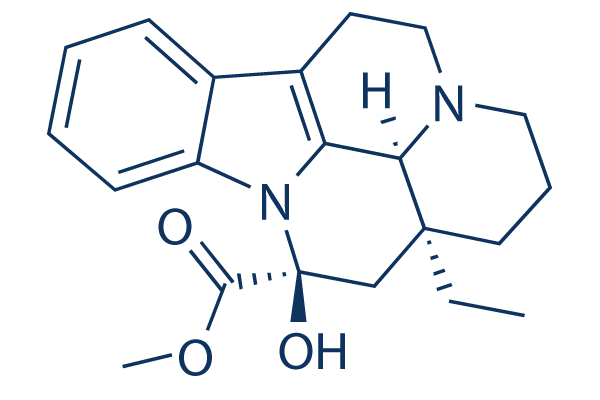
Chemische structuur
Molecuulgewicht: 354.44
Kwaliteitscontrole (Quality Control)
Chemische informatie, opslag en stabiliteit (Chemical Information, Storage & Stability)
| Molecuulgewicht | 354.44 | Formule | C21H26N2O3 |
Opslag (vanaf de datum van ontvangst) | |
|---|---|---|---|---|---|
| CAS-nr. | 1617-90-9 | SDF downloaden | Opslag van stamoplossingen |
|
|
| Synoniemen | Angiopac, Devincan, Equipur, Minorin, Novicet, Oxybral, Perval, Sostenil, Tripervan | Smiles | CCC12CCCN3C1C4=C(CC3)C5=CC=CC=C5N4C(C2)(C(=O)OC)O | ||
Oplosbaarheid (Solubility)
|
In vitro |
DMSO
: 3 mg/mL
(8.46 mM)
|
Molariteitscalculator
|
In vivo |
|||||
In vivo formulatiecalculator (heldere oplossing)
Stap 1: Voer onderstaande informatie in (Aanbevolen: een extra dier om rekening te houden met verlies tijdens het experiment)
Stap 2: Voer de in vivo formulering in (Dit is alleen de calculator, geen formulering. Neem eerst contact met ons op als er geen in vivo formulering is in de sectie oplosbaarheid.)
Berekeningsresultaten:
Werkconcentratie: mg/ml;
Methode voor het bereiden van DMSO-moedervloeistof: mg geneesmiddel vooropgelost in μL DMSO ( Concentratie moedervloeistof mg/mL, Neem eerst contact met ons op als de concentratie de DMSO-oplosbaarheid van de batch van het geneesmiddel overschrijdt. )
Methode voor het bereiden van in vivo formulering: Neem μL DMSO moedervloeistof, voeg daarna toeμL PEG300, mengen en verhelderen, daarna toevoegenμL Tween 80, mengen en verhelderen, daarna toevoegen μL ddH2O, mengen en verhelderen.
Methode voor het bereiden van in vivo formulering: Neem μL DMSO moedervloeistof, voeg daarna toe μL Maïsolie, mengen en verhelderen.
Opmerking: 1. Zorg ervoor dat de vloeistof helder is voordat u het volgende oplosmiddel toevoegt.
2. Zorg ervoor dat u het/de oplosmiddel(en) in de juiste volgorde toevoegt. U moet ervoor zorgen dat de verkregen oplossing, bij de vorige toevoeging, een heldere oplossing is voordat u verdergaat met het toevoegen van het volgende oplosmiddel. Fysieke methoden zoals vortexen, ultrasoon of een warmwaterbad kunnen worden gebruikt om het oplossen te bevorderen.
Werkingsmechanisme (Mechanism of Action)
| In vitro |
Vincamine decreases amyloid-β 25-35 induced oxidative stress and reduces reactive oxygen species levels. It significantly reduces the rate of apoptosis in a dose-dependent manner. This compound could provide neuroprotection from Aβ25-35 induced PC12 apoptosis through the phosphatidylinositol-3 kinase/Akt signaling pathway.
|
|---|---|
| In vivo |
Vincamine could cross the blood-brain barrier, and its antioxidant scavenging capacity to inactivate hydroxyl free radicals is actually ranked in part with Vitamin E. This compound decreases the mean arterial blood pressure (by 5-35%), the cardial output and the heart rate. After oral application of 20 mg/kg vincamine in rats, this chemical is rapidly absorbed and eliminated. The apparent elimination half life is 1.71 h. The bioavailability of this compound after oral administration is 58% suggesting a significant firstpass metabolism. It is taken up in a high concentration by the different organs, the maximal organ-plasma concentration ratio is 21 for lungs, 14.6 for brain, 14.3 for the kidneys, 8.9 for the liver and 7.6 for the heart. There is no steady-state between plasma and heart, lungs and brain, the elimination from these organs is significantly more rapid than from plasma. This chemical is mainly metabolized in the liver and excreted by the kidneys and it may also go through cerebral metabolism. In the pharmacokinetic profile of vincamine, the compound is about 64% bound to plasma proteins, and 6% bound to erythrocytes.
|
Referenties |
|

Producten zijn uitsluitend voor onderzoeksdoeleinden. Niet voor menselijk gebruik. Wij verkopen niet aan patiënten.
©Copyright 2013 Selleck Chemicals. Alle rechten voorbehouden.