
alleen voor onderzoeksdoeleinden
Istradefylline Adenosine Receptor Antagonist
Cat.nr.: S2790
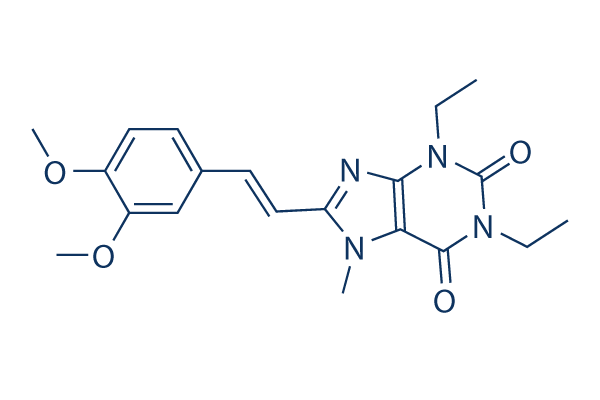
Chemische structuur
Molecuulgewicht: 384.43
Kwaliteitscontrole (Quality Control)
| Gerelateerde doelwitten | CXCR Hedgehog/Smoothened PKA Adrenergic Receptor AChR 5-HT Receptor Histamine Receptor Dopamine Receptor Ras KRas |
|---|---|
| Overig Adenosine Receptor Inhibitoren | Reversine CGS 21680 HCl ZM241385 SCH58261 Ciforadenant (CPI-444) A2AR antagonist 1 Imaradenant (AZD4635) Etrumadenant (AB928) SCH-442416 DPCPX |
Chemische informatie, opslag en stabiliteit (Chemical Information, Storage & Stability)
| Molecuulgewicht | 384.43 | Formule | C20H24N4O4 |
Opslag (vanaf de datum van ontvangst) | |
|---|---|---|---|---|---|
| CAS-nr. | 155270-99-8 | SDF downloaden | Opslag van stamoplossingen |
|
|
| Synoniemen | KW-6002 | Smiles | CCN1C2=C(C(=O)N(C1=O)CC)N(C(=N2)C=CC3=CC(=C(C=C3)OC)OC)C | ||
Oplosbaarheid (Solubility)
|
In vitro |
DMSO
: 6 mg/mL
(15.6 mM)
Water : Insoluble Ethanol : Insoluble |
Molariteitscalculator
|
In vivo |
|||||
In vivo formulatiecalculator (heldere oplossing)
Stap 1: Voer onderstaande informatie in (Aanbevolen: een extra dier om rekening te houden met verlies tijdens het experiment)
Stap 2: Voer de in vivo formulering in (Dit is alleen de calculator, geen formulering. Neem eerst contact met ons op als er geen in vivo formulering is in de sectie oplosbaarheid.)
Berekeningsresultaten:
Werkconcentratie: mg/ml;
Methode voor het bereiden van DMSO-moedervloeistof: mg geneesmiddel vooropgelost in μL DMSO ( Concentratie moedervloeistof mg/mL, Neem eerst contact met ons op als de concentratie de DMSO-oplosbaarheid van de batch van het geneesmiddel overschrijdt. )
Methode voor het bereiden van in vivo formulering: Neem μL DMSO moedervloeistof, voeg daarna toeμL PEG300, mengen en verhelderen, daarna toevoegenμL Tween 80, mengen en verhelderen, daarna toevoegen μL ddH2O, mengen en verhelderen.
Methode voor het bereiden van in vivo formulering: Neem μL DMSO moedervloeistof, voeg daarna toe μL Maïsolie, mengen en verhelderen.
Opmerking: 1. Zorg ervoor dat de vloeistof helder is voordat u het volgende oplosmiddel toevoegt.
2. Zorg ervoor dat u het/de oplosmiddel(en) in de juiste volgorde toevoegt. U moet ervoor zorgen dat de verkregen oplossing, bij de vorige toevoeging, een heldere oplossing is voordat u verdergaat met het toevoegen van het volgende oplosmiddel. Fysieke methoden zoals vortexen, ultrasoon of een warmwaterbad kunnen worden gebruikt om het oplossen te bevorderen.
Werkingsmechanisme (Mechanism of Action)
| Targets/IC50/Ki |
Adenosine A2A receptor
2.2 nM(Ki)
|
|---|---|
| In vitro |
The affinity of Istradefylline for the A2AR is 70-fold greater than that for the A1 receptor with Ki of 2.2 nM versus 150 nM. Exposure of primary rat striatal astrocytes to this compound results in concentration-dependent abolition of bFGF induction of astrogliosis in vitro. Binding affinities (Ki) of this chemical for A1 receptor, A2A receptor, and A3 receptor in human are >287 nM, 9.12 nM, and >681 nM, respectively, for A1 receptor and A2A receptor in rat 50.9 nM and 1.57 nM, respectively, and for A1 receptor and A2A receptor in mouse 105.02 nM and 1.87 nM, respectively. |
| In vivo |
Istradefylline reverses CGS21680-induced and reserpine-induced catalepsy with ED50 of 0.05 mg/kg and 0.26 mg/kg, respectively. This compound is over 10 times as potent in these models compared to other adenosine antagonists and dopamine agonist drugs. Administration of this chemical in combination with LevoDOPA (50 mg/kg) exerts prominent effects on haloperidol-induced and reserpine-induced catalepsy. Oral administration of this compound at 10 mg/kg to MPTP-treated common marmosets produces an increase in locomotor activity to approximately twice that of control and improves motor disability. Administration of this chemical (10 mg/kg, po, 90 minutes before SKF80723/quinpirole/LevoDOPA) in combination with SKF80723 (1 mg/kg, ip), quinpirole (0.06 mg/kg ip), or LevoDOPA (2.5 mg/kg po) produces a significant additive effect on locomotor activity and improvement of motor disability but not dyskinesia. In the MPTP mice model, this compound significantly attenuates striatal dopamine depletion under various conditions. Pretreatment with this chemical (3.3 mg/kg, i.p.) before a single dose of MPTP attenuates the partial dopamine and DOPAC depletions measured in striata 1 week later. Oral administration of this compound protects against the loss of nigral dopaminergic neuronal cells induced by 6-hydroxydopamine in rats, and prevents the functional loss of dopaminergic nerve terminals in the striatum and the ensuing gliosis caused by MPTP in mice. Chronic treatment with this compound does not improve the reversal deficits in dopamine-depleted rats. The tremulous jaw movements induced by pimozide are significantly reduced by co-administration of either this chemical or tropicamide. Pimozide-induced increases in ventrolateral striatal c-Fos expression are reduced by a behaviorally effective dose of this compound, in contrast to tropicamide by which c-Fos expression in pimozide-treated rats is actually increased. |
Referenties |
|
Informatie over klinische proeven (Clinical Trial Information)
(gegevens van https://clinicaltrials.gov, bijgewerkt op 2026-07-15)
| NCT-nummer | Werving | Aandoeningen | Sponsor/medewerkers | Startdatum | Fasen |
|---|---|---|---|---|---|
| NCT07704385 | NOT_YET_RECRUITING | Adults |
University of Florida |
2026-10-01 | PHASE1; PHASE2 |
| NCT05217498 | NOT_YET_RECRUITING | Spinal Cord Injuries; Myelopathy |
Randy Trumbower, PT, PhD |
2027-09-01 | PHASE1; PHASE2 |
| NCT05377424 | ACTIVE_NOT_RECRUITING | ALS |
University of Florida |
2022-06-21 | PHASE1; PHASE2 |
| NCT05333549 | COMPLETED | Parkinson Disease; Cognitive Impairment |
Virginia Commonwealth University |
2022-07-18 | PHASE2 |
| NCT05885360 | COMPLETED | Parkinson Disease; Tremor |
Georgetown University |
2023-01-20 | PHASE4 |
| NCT05885360 | Active not recruiting | Parkinson Disease|Tremor |
Georgetown University|Kyowa Kirin Inc. |
2023-01-20 | Phase 4 |

Producten zijn uitsluitend voor onderzoeksdoeleinden. Niet voor menselijk gebruik. Wij verkopen niet aan patiënten.
©Copyright 2013 Selleck Chemicals. Alle rechten voorbehouden.