
alleen voor onderzoeksdoeleinden
Histamine Phosphate Histamine Receptor Agonist
Cat.nr.: S4117
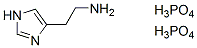
Chemische structuur
Molecuulgewicht: 307.14
Spring naar
Kwaliteitscontrole (Quality Control)
Batch:
Zuiverheid:
99.99%
99.99
| Gerelateerde doelwitten | Adrenergic Receptor AChR 5-HT Receptor COX Calcium Channel Dopamine Receptor GABA Receptor TRP Channel Cholinesterase (ChE) GluR |
|---|---|
| Overig Histamine Receptor Inhibitoren | GSK2879552 Dihydrochloride JNJ-7777120 Ebastine Mianserin HCl Ciproxifan Maleate Astemizole Lafutidine Mizolastine Cloperastine hydrochloride Rupatadine |
Chemische informatie, opslag en stabiliteit (Chemical Information, Storage & Stability)
| Molecuulgewicht | 307.14 | Formule | C5H9N.2H3O4P |
Opslag (vanaf de datum van ontvangst) | |
|---|---|---|---|---|---|
| CAS-nr. | 51-74-1 | SDF downloaden | Opslag van stamoplossingen |
|
|
| Synoniemen | Histamine diphosphate | Smiles | C1=C(NC=N1)CCN.OP(=O)(O)O.OP(=O)(O)O | ||
Oplosbaarheid (Solubility)
|
In vitro |
Water : 61 mg/mL
DMSO
: Insoluble
Ethanol : Insoluble |
Molariteitscalculator
Verdunningscalculator
Molecuulgewichtcalculator
|
In vivo |
|||||
In vivo formulatiecalculator (heldere oplossing)
Stap 1: Voer onderstaande informatie in (Aanbevolen: een extra dier om rekening te houden met verlies tijdens het experiment)
mg/kg
g
μL
Stap 2: Voer de in vivo formulering in (Dit is alleen de calculator, geen formulering. Neem eerst contact met ons op als er geen in vivo formulering is in de sectie oplosbaarheid.)
% DMSO
%
% Tween 80
% ddH2O
%DMSO
%
Berekeningsresultaten:
Werkconcentratie: mg/ml;
Methode voor het bereiden van DMSO-moedervloeistof: mg geneesmiddel vooropgelost in μL DMSO ( Concentratie moedervloeistof mg/mL, Neem eerst contact met ons op als de concentratie de DMSO-oplosbaarheid van de batch van het geneesmiddel overschrijdt. )
Methode voor het bereiden van in vivo formulering: Neem μL DMSO moedervloeistof, voeg daarna toeμL PEG300, mengen en verhelderen, daarna toevoegenμL Tween 80, mengen en verhelderen, daarna toevoegen μL ddH2O, mengen en verhelderen.
Methode voor het bereiden van in vivo formulering: Neem μL DMSO moedervloeistof, voeg daarna toe μL Maïsolie, mengen en verhelderen.
Opmerking: 1. Zorg ervoor dat de vloeistof helder is voordat u het volgende oplosmiddel toevoegt.
2. Zorg ervoor dat u het/de oplosmiddel(en) in de juiste volgorde toevoegt. U moet ervoor zorgen dat de verkregen oplossing, bij de vorige toevoeging, een heldere oplossing is voordat u verdergaat met het toevoegen van het volgende oplosmiddel. Fysieke methoden zoals vortexen, ultrasoon of een warmwaterbad kunnen worden gebruikt om het oplossen te bevorderen.
Werkingsmechanisme (Mechanism of Action)
| Kenmerken |
Histamine phosphate is indicated as a diagnostic aid for evaluation of gastric acid secretory function.
|
|---|---|
| Targets/IC50/Ki |
Histamine H1 receptor
Histamine H2 receptor
|
| In vitro |
Histamine (10 μM) gives a larger inositol monophosphate accumulation in bovine adrenal chromaffin cells. Histamine (10 μM) stimulates the level of radioactivity into the InsP3-containing fraction in bovine adrenal chromaffin cells. Histamine (100 μM) stimulates incorporation into the InsP3-containing eluate in a less extent than for angiotensin I1 and bradykinin. |
| In vivo |
Histamine phosphate (0.025 mg/kg) produces a mean increase in basilar blood flow of 145% of control in dogs. Histamine phosphate produces considerable increases in basilar blood flow as well as a decrease in femoral arterial blood pressure in dogs when injected intravenously and measured with an electromagnetic flow transducer. Histamine phosphate (4 μg/kg) causes lymph flow to increase from 6.0 to 27.0 (SEM) ml/h in unanesthetized sheep. Histamine phosphate (4 μg/kg) also causes increases in lung water, pulmonary vascular resistance, arterial PCO2, pH, and hematocrit, and decreases in cardiac output and arterial PO2 in unanesthetized sheep. Histamine phosphate (8.3 mg/kg/min) causes no significant change in pulmonary lymph flow (QL) or protein concentration (CL) in anesthetized open-chested dogs, however, both are increased after alloxan. Histamine phosphate (8.3 mg/kg/min) also causes no significant change in the pulmonary capillary membrane filtration coefficient (Kf) and the maximum capillary pressure (PCcritical) in anesthetized open-chested dogs. Histamine phosphate (50 mg/kg) produces a pronounced rise in acid secretion but the output of pepsin remained unchanged in the unanaesthetized intact rat. Histamine phosphate (50 mg/kg) produces maximal stimulation of gastric acid secretion and is free from toxic effects in the unanaesthetized intact rat. |
Referenties |
|
Informatie over klinische proeven (Clinical Trial Information)
(gegevens van https://clinicaltrials.gov, bijgewerkt op 2024-05-22)
| NCT-nummer | Werving | Aandoeningen | Sponsor/medewerkers | Startdatum | Fasen |
|---|---|---|---|---|---|
| NCT06281366 | Recruiting | Pregnancy Complications |
Hospital Universitari Vall d''Hebron Research Institute|DR Healthcare |
2024-02-16 | -- |
| NCT05216133 | Enrolling by invitation | Airway Disease|Barrett Esophagus|Gastroesophageal Reflux Disease |
NYU Langone Health|National Institute for Occupational Safety and Health (NIOSH/CDC) |
2023-03-22 | -- |
| NCT05701826 | Completed | Skeletal Muscle Relaxation |
Fujian Shengdi Pharmaceutical Co. Ltd. |
2023-02-15 | Phase 1 |
| NCT05676346 | Completed | Lower Urinary Tract Symptoms|Histamine Intolerance |
Complexo Hospitalario Universitario de A Coruña |
2022-10-11 | -- |

Producten zijn uitsluitend voor onderzoeksdoeleinden. Niet voor menselijk gebruik. Wij verkopen niet aan patiënten.
©Copyright 2013 Selleck Chemicals. Alle rechten voorbehouden.