
alleen voor onderzoeksdoeleinden
GNF-2 Bcr-Abl Remmer
Cat.nr.: S2899
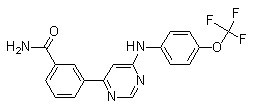
Chemische structuur
Molecuulgewicht: 374.32
Kwaliteitscontrole (Quality Control)
| Gerelateerde doelwitten | EGFR VEGFR JAK FGFR PDGFR Src HIF FLT3 HER2 FLT |
|---|---|
| Overig Bcr-Abl Inhibitoren | Degrasyn (WP1130) Bafetinib (INNO-406) Rebastinib (DCC-2036) GNF-5 Berbamine Olverembatinib dimesylate (GZD824) PD173955 GNF-7 Berbamine dihydrochloride Radotinib |
Chemische informatie, opslag en stabiliteit (Chemical Information, Storage & Stability)
| Molecuulgewicht | 374.32 | Formule | C18H13F3N4O2 |
Opslag (vanaf de datum van ontvangst) | |
|---|---|---|---|---|---|
| CAS-nr. | 778270-11-4 | SDF downloaden | Opslag van stamoplossingen |
|
|
| Synoniemen | N/A | Smiles | C1=CC(=CC(=C1)C(=O)N)C2=CC(=NC=N2)NC3=CC=C(C=C3)OC(F)(F)F | ||
Oplosbaarheid (Solubility)
|
In vitro |
DMSO
: 74 mg/mL
(197.69 mM)
Water : Insoluble Ethanol : Insoluble |
Molariteitscalculator
|
In vivo |
|||||
In vivo formulatiecalculator (heldere oplossing)
Stap 1: Voer onderstaande informatie in (Aanbevolen: een extra dier om rekening te houden met verlies tijdens het experiment)
Stap 2: Voer de in vivo formulering in (Dit is alleen de calculator, geen formulering. Neem eerst contact met ons op als er geen in vivo formulering is in de sectie oplosbaarheid.)
Berekeningsresultaten:
Werkconcentratie: mg/ml;
Methode voor het bereiden van DMSO-moedervloeistof: mg geneesmiddel vooropgelost in μL DMSO ( Concentratie moedervloeistof mg/mL, Neem eerst contact met ons op als de concentratie de DMSO-oplosbaarheid van de batch van het geneesmiddel overschrijdt. )
Methode voor het bereiden van in vivo formulering: Neem μL DMSO moedervloeistof, voeg daarna toeμL PEG300, mengen en verhelderen, daarna toevoegenμL Tween 80, mengen en verhelderen, daarna toevoegen μL ddH2O, mengen en verhelderen.
Methode voor het bereiden van in vivo formulering: Neem μL DMSO moedervloeistof, voeg daarna toe μL Maïsolie, mengen en verhelderen.
Opmerking: 1. Zorg ervoor dat de vloeistof helder is voordat u het volgende oplosmiddel toevoegt.
2. Zorg ervoor dat u het/de oplosmiddel(en) in de juiste volgorde toevoegt. U moet ervoor zorgen dat de verkregen oplossing, bij de vorige toevoeging, een heldere oplossing is voordat u verdergaat met het toevoegen van het volgende oplosmiddel. Fysieke methoden zoals vortexen, ultrasoon of een warmwaterbad kunnen worden gebruikt om het oplossen te bevorderen.
Werkingsmechanisme (Mechanism of Action)
| Targets/IC50/Ki |
Bcr-Abl (SUP-B15 cell line)
268 nM
Bcr-Abl (K562 cell line)
273 nM
|
|---|---|
| In vitro |
GNF-2 causes a dose-dependent growth inhibition of the Bcr-abl–positive cell lines with IC50 values of 273 nM (K562) and 268 nM (SUP-B15). This compound inhibits the growth of Ba/F3.p210E255V and Ba/F3.p185Y253H cells with IC50 values of 268 nM and 194 nM respectively. This chemical (1 μM) induces apoptosis of Ba/F3.p210 cells as well as Ba/F3.p210E255V cells. It inhibits the cellular tyrosine phosphorylation of Bcr-abl in a dose-dependent manner with IC50 of 267 nM. This compound (1 μM) induces a significant decrease in the levels of phospho-Stat5 in Ba/F3.p210 cells. It binds to the myristic binding pocket of Bcr-abl. This inhibitor inhibits the kinase activity of non-myristoylated c-Abl more potently than that of myristoylated c-Abl by binding to the myristate-binding pocket in the C-lobe of the kinase domain. This agent (10 μM) requires BCR and/or the c-Abl SH3 and/or SH2 domains to inhibit BCR-Abl-dependent cell proliferation. It, but not a methylated GNF-2 analog, binds c-Abl in cellular extracts derived from 3T3 fibroblasts. This compound (10 μM), in a dose-dependent manner, clearly inhibits tyrosine phosphorylation of CrkII. It inhibits the phosphorylation of CrkII in c-AblG2A-expressing cells with IC50 of 0.051 μM. This chemical binds in an extended conformation in the myristate pocket with the CF3-group buried at the same depth as the final two carbons of the myristate ligand. This compound (10 µM) combined with imatinib (1 µM) reduces the number of resistant clones to 1 µM imatinib by at least 90%. It inhibits the auto-phosphorylation and proliferation of BafF3 cells expressing p210Bcr–Abl and p210Bcr–Abl mutants. This agent (8 nM) in combination with GNF-5 (20 nM) results in additive effects with respect to inhibition of the Abl64–515 kinase activity.
|
| Kinase Assay |
Bindingstest
|
|
Recombinant proteïnen (100 nM voor elk construct) of geïmmunoprecipiteerde proteïnen worden verdund in kinasebuffer (20 mM HEPES (pH 7.4), 50 mM KCl, 0.1% CHAPS, 30 mM MgCl2, 2 mM MnCl2, 1 mM DTT en 1% glycerol). Aliquoten van de verdunde proteïnen worden 30 min bij kamertemperatuur voorgeïncubeerd met ofwel DMSO of deze verbinding en vervolgens toegevoegd aan K-LISA PTK EAY reactieplaten. De kinasereactie wordt gestart door toevoeging van 0.1 mM ATP en mag 30 min bij kamertemperatuur doorgaan. De fosforylering van GST-Abltide wordt gemonitord door SDS-PAGE en fosforbeeldanalyse of autoradiografie.
|
Referenties |
|

Producten zijn uitsluitend voor onderzoeksdoeleinden. Niet voor menselijk gebruik. Wij verkopen niet aan patiënten.
©Copyright 2013 Selleck Chemicals. Alle rechten voorbehouden.