
alleen voor onderzoeksdoeleinden
Gambogic Acid Bcl-2 Remmer
Cat.nr.: S2448
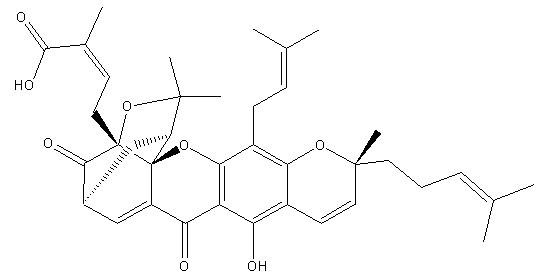
Chemische structuur
Molecuulgewicht: 628.75
Kwaliteitscontrole (Quality Control)
| Gerelateerde doelwitten | Caspase PD-1/PD-L1 Ferroptosis p53 Apoptosis related Synthetic Lethality STAT TNF-alpha Ras KRas |
|---|---|
| Overig Bcl-2 Inhibitoren | Navitoclax (ABT-263) S63845 ABT-737 Obatoclax Mesylate (GX15-070) A-1331852 A-1210477 TW-37 A-1155463 Dihydrochloride AZD5991 UMI-77 |
Chemische informatie, opslag en stabiliteit (Chemical Information, Storage & Stability)
| Molecuulgewicht | 628.75 | Formule | C38H44O8 |
Opslag (vanaf de datum van ontvangst) | |
|---|---|---|---|---|---|
| CAS-nr. | 2752-65-0 | SDF downloaden | Opslag van stamoplossingen |
|
|
| Synoniemen | Guttatic Acid, Guttic Acid, Beta-Guttiferrin | Smiles | CC(=CCCC1(C=CC2=C(C3=C(C(=C2O1)CC=C(C)C)OC45C6CC(C=C4C3=O)C(=O)C5(OC6(C)C)CC=C(C)C(=O)O)O)C)C | ||
Oplosbaarheid (Solubility)
|
In vitro |
DMSO
: 100 mg/mL
(159.04 mM)
Ethanol : 100 mg/mL Water : Insoluble |
Molariteitscalculator
|
In vivo |
|||||
In vivo formulatiecalculator (heldere oplossing)
Stap 1: Voer onderstaande informatie in (Aanbevolen: een extra dier om rekening te houden met verlies tijdens het experiment)
Stap 2: Voer de in vivo formulering in (Dit is alleen de calculator, geen formulering. Neem eerst contact met ons op als er geen in vivo formulering is in de sectie oplosbaarheid.)
Berekeningsresultaten:
Werkconcentratie: mg/ml;
Methode voor het bereiden van DMSO-moedervloeistof: mg geneesmiddel vooropgelost in μL DMSO ( Concentratie moedervloeistof mg/mL, Neem eerst contact met ons op als de concentratie de DMSO-oplosbaarheid van de batch van het geneesmiddel overschrijdt. )
Methode voor het bereiden van in vivo formulering: Neem μL DMSO moedervloeistof, voeg daarna toeμL PEG300, mengen en verhelderen, daarna toevoegenμL Tween 80, mengen en verhelderen, daarna toevoegen μL ddH2O, mengen en verhelderen.
Methode voor het bereiden van in vivo formulering: Neem μL DMSO moedervloeistof, voeg daarna toe μL Maïsolie, mengen en verhelderen.
Opmerking: 1. Zorg ervoor dat de vloeistof helder is voordat u het volgende oplosmiddel toevoegt.
2. Zorg ervoor dat u het/de oplosmiddel(en) in de juiste volgorde toevoegt. U moet ervoor zorgen dat de verkregen oplossing, bij de vorige toevoeging, een heldere oplossing is voordat u verdergaat met het toevoegen van het volgende oplosmiddel. Fysieke methoden zoals vortexen, ultrasoon of een warmwaterbad kunnen worden gebruikt om het oplossen te bevorderen.
Werkingsmechanisme (Mechanism of Action)
| Targets/IC50/Ki |
Bcl-w
0.02 μM
Bcl-B
0.66 μM
Mcl-1
0.79 μM
Bfl-1
1.06 μM
Bcl-2
1.21 μM
Bcl-xL
1.47 μM
Caspase
<1.64 μM(EC50)
|
|---|---|
| In vitro |
Gambogic Acid is a caged xanthone that is derived from Garcinia hanburyi and functions as a strong apoptotic inducer in many types of cancer cells by inhibiting human Bcl-2 family proteins and activating caspases. This compound also blocks Kir2.1 channels with EC50 of ≤ 100 nM. It significantly inhibits human umbilical vein endothelial cell (HUVEC) proliferation, migration, invasion, tube formation, and micro-vessel growth at nM concentration.
|
| In vivo |
Gambogic Acid effectively inhibits tumor angiogenesis and suppressed tumor growth with low side effects using metronomic chemotherapy with this compound. It has multiple functional effects including the induction of apoptosis, the inhibition of proliferation and the prevention of cancer metastasis and tumor angiogenesis. In both animal tumor models and clinical trials, this agent efficiently inhibits tumor growth with minimal side effects, with little toxicity on immune and hemopoietic systems. This chemical can produce tissue-specific proteasome inhibition and tumor-specific toxicity. LD50: Mice 45mg/kg (i.p.).
|
Referenties |
|

Producten zijn uitsluitend voor onderzoeksdoeleinden. Niet voor menselijk gebruik. Wij verkopen niet aan patiënten.
©Copyright 2013 Selleck Chemicals. Alle rechten voorbehouden.