
alleen voor onderzoeksdoeleinden
Clindamycin Bacterial Remmer
Cat.nr.: S2830
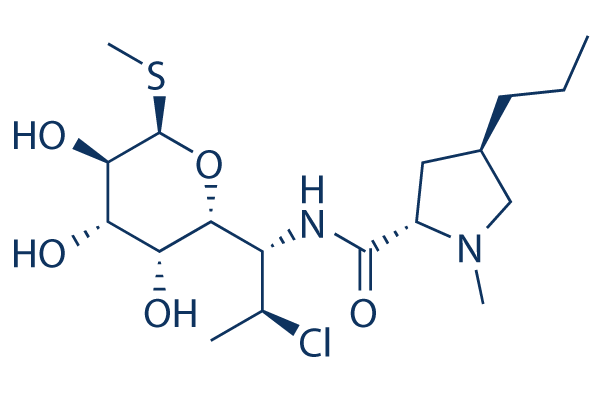
Chemische structuur
Molecuulgewicht: 424.98
Kwaliteitscontrole (Quality Control)
| Gerelateerde doelwitten | Integrase Antibiotics Anti-infection Fungal Antiviral COVID-19 Parasite Reverse Transcriptase HIV HCV Protease |
|---|---|
| Overig Bacterial Inhibitoren | BTZ043 Racemate Teicoplanin Pefloxacin Mesylate Solithromycin Ceftiofur 6-Methoxydihydrosanguinarine Ornidazole Closantel Sodium Florfenicol Furaltadone HCl |
Chemische informatie, opslag en stabiliteit (Chemical Information, Storage & Stability)
| Molecuulgewicht | 424.98 | Formule | C18H33ClN2O5S |
Opslag (vanaf de datum van ontvangst) | |
|---|---|---|---|---|---|
| CAS-nr. | 18323-44-9 | -- | Opslag van stamoplossingen |
|
|
| Synoniemen | N/A | Smiles | CCCC1CC(N(C1)C)C(=O)NC(C2C(C(C(C(O2)SC)O)O)O)C(C)Cl | ||
Oplosbaarheid (Solubility)
|
In vitro |
DMSO
: 85 mg/mL
(200.0 mM)
Ethanol : 85 mg/mL Water : Insoluble |
Molariteitscalculator
|
In vivo |
|||||
In vivo formulatiecalculator (heldere oplossing)
Stap 1: Voer onderstaande informatie in (Aanbevolen: een extra dier om rekening te houden met verlies tijdens het experiment)
Stap 2: Voer de in vivo formulering in (Dit is alleen de calculator, geen formulering. Neem eerst contact met ons op als er geen in vivo formulering is in de sectie oplosbaarheid.)
Berekeningsresultaten:
Werkconcentratie: mg/ml;
Methode voor het bereiden van DMSO-moedervloeistof: mg geneesmiddel vooropgelost in μL DMSO ( Concentratie moedervloeistof mg/mL, Neem eerst contact met ons op als de concentratie de DMSO-oplosbaarheid van de batch van het geneesmiddel overschrijdt. )
Methode voor het bereiden van in vivo formulering: Neem μL DMSO moedervloeistof, voeg daarna toeμL PEG300, mengen en verhelderen, daarna toevoegenμL Tween 80, mengen en verhelderen, daarna toevoegen μL ddH2O, mengen en verhelderen.
Methode voor het bereiden van in vivo formulering: Neem μL DMSO moedervloeistof, voeg daarna toe μL Maïsolie, mengen en verhelderen.
Opmerking: 1. Zorg ervoor dat de vloeistof helder is voordat u het volgende oplosmiddel toevoegt.
2. Zorg ervoor dat u het/de oplosmiddel(en) in de juiste volgorde toevoegt. U moet ervoor zorgen dat de verkregen oplossing, bij de vorige toevoeging, een heldere oplossing is voordat u verdergaat met het toevoegen van het volgende oplosmiddel. Fysieke methoden zoals vortexen, ultrasoon of een warmwaterbad kunnen worden gebruikt om het oplossen te bevorderen.
Werkingsmechanisme (Mechanism of Action)
| In vitro |
Clindamycin is a semisynthetic analogue of lincomycin. It primarily inhibits the initiation of peptide chain synthesis by deregulating enzyme-catalyzed initiation of peptide bounds. This compound appears to have a modest effect on protein synthesis by certain mammalian cells. It is active against most gram-positive aerobic bacteria. This antibiotic is about eight times more active than lincomycin against Staphylococcus aureus and Streptococcus pneumonia. It is four times more active than erythromycin against S. aureus and is active even against strains that are resistant to erythromycin, penicillin, and methicillin. It is active against gram-positive anaerobes. This agent highly activates against Bacteroides specie. It also alters the bacterial surface in such a way that phagocytosis and intracellular killing of the bacteria is greatly facilitated. This drug potentiates opsonization and phagocytosis.
|
|---|---|
| In vivo |
Clindamycin (50mg/kg daily administrated by intramuscular) increases the survival rate of monkeys infected with penicillin-resistant S. aureu to 87.5% (7/8). This compound (40 mg/kg administrated three times daily) protects 87.5% (7/8) of rabbits from anaerobic pulmonary infections induced by transtracheal inoculation of a mixture of B. fragillis, Streptococcus morbillorm, Fusobacterium nucleatum and Eubacterium lentum. This chemical (400 mg/kg treated by mixed in the diet) increases survival rate of mice infected with the Toxoplasma gondii to 100%, while all animals die in untreated group.
|
Referenties |
|
Informatie over klinische proeven (Clinical Trial Information)
(gegevens van https://clinicaltrials.gov, bijgewerkt op 2026-01-21)
| NCT-nummer | Werving | Aandoeningen | Sponsor/medewerkers | Startdatum | Fasen |
|---|---|---|---|---|---|
| NCT07357103 | NOT_YET_RECRUITING | Pneumocystis; Pneumocystis Infection; Pneumocystis Carinii Infection; Pneumocystis Carinii; Infection, Resulting From HIV Disease; Pneumocystis Jirovecii Pneumonia; Pneumocystis Jirovecii Infection; Pneumocystosis Associated With AIDS; Pneumocystosis; Pneumonia (Etiology) |
McGill University Health Centre/Research Institute of the McGill University Health Centre |
2026-03 | PHASE4 |
| NCT05137119 | RECRUITING | Staphylococcus Aureus Bacteremia |
University of Melbourne |
2022-02-16 | PHASE4 |
| NCT05137119 | RECRUITING | Staphylococcus Aureus Bacteremia |
University of Melbourne |
2022-02-16 | PHASE4 |
| NCT06494072 | RECRUITING | Community Acquired Pneumonia in Children |
Medical College of Wisconsin |
2024-08-22 | PHASE4 |
| NCT06494072 | RECRUITING | Community Acquired Pneumonia in Children |
Medical College of Wisconsin |
2024-08-22 | PHASE4 |

Producten zijn uitsluitend voor onderzoeksdoeleinden. Niet voor menselijk gebruik. Wij verkopen niet aan patiënten.
©Copyright 2013 Selleck Chemicals. Alle rechten voorbehouden.