
alleen voor onderzoeksdoeleinden
Bestatin (Ubenimex) Immunology & Inflammation related Remmer
Cat.nr.: S1591
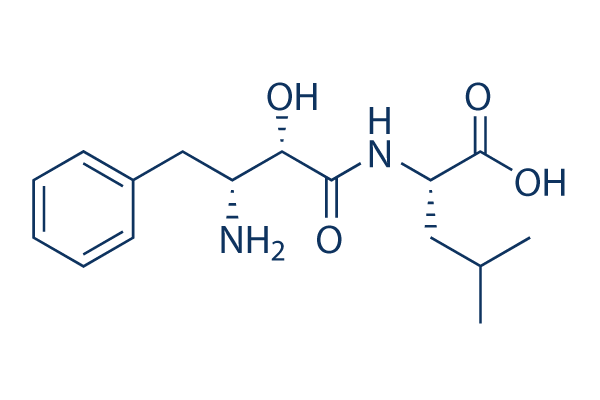
Chemische structuur
Molecuulgewicht: 308.37
Kwaliteitscontrole (Quality Control)
| Gerelateerde doelwitten | PD-1/PD-L1 CXCR STING AhR CD markers Interleukins Anti-infection Antioxidant COX Histamine Receptor |
|---|---|
| Overig Immunology & Inflammation related Inhibitoren | Cl-amidine Bindarit (AF 2838) Tempol Tranilast Sinomenine GI254023X (GI4023) Geniposidic acid CORM-3 Oxymatrine Germacrone |
Chemische informatie, opslag en stabiliteit (Chemical Information, Storage & Stability)
| Molecuulgewicht | 308.37 | Formule | C16H24N2O4 |
Opslag (vanaf de datum van ontvangst) | |
|---|---|---|---|---|---|
| CAS-nr. | 58970-76-6 | SDF downloaden | Opslag van stamoplossingen |
|
|
| Synoniemen | NK421 | Smiles | CC(C)CC(C(=O)O)NC(=O)C(C(CC1=CC=CC=C1)N)O | ||
Oplosbaarheid (Solubility)
|
In vitro |
DMSO
: 7 mg/mL
(22.7 mM)
Water : Insoluble Ethanol : Insoluble |
Molariteitscalculator
|
In vivo |
|||||
In vivo formulatiecalculator (heldere oplossing)
Stap 1: Voer onderstaande informatie in (Aanbevolen: een extra dier om rekening te houden met verlies tijdens het experiment)
Stap 2: Voer de in vivo formulering in (Dit is alleen de calculator, geen formulering. Neem eerst contact met ons op als er geen in vivo formulering is in de sectie oplosbaarheid.)
Berekeningsresultaten:
Werkconcentratie: mg/ml;
Methode voor het bereiden van DMSO-moedervloeistof: mg geneesmiddel vooropgelost in μL DMSO ( Concentratie moedervloeistof mg/mL, Neem eerst contact met ons op als de concentratie de DMSO-oplosbaarheid van de batch van het geneesmiddel overschrijdt. )
Methode voor het bereiden van in vivo formulering: Neem μL DMSO moedervloeistof, voeg daarna toeμL PEG300, mengen en verhelderen, daarna toevoegenμL Tween 80, mengen en verhelderen, daarna toevoegen μL ddH2O, mengen en verhelderen.
Methode voor het bereiden van in vivo formulering: Neem μL DMSO moedervloeistof, voeg daarna toe μL Maïsolie, mengen en verhelderen.
Opmerking: 1. Zorg ervoor dat de vloeistof helder is voordat u het volgende oplosmiddel toevoegt.
2. Zorg ervoor dat u het/de oplosmiddel(en) in de juiste volgorde toevoegt. U moet ervoor zorgen dat de verkregen oplossing, bij de vorige toevoeging, een heldere oplossing is voordat u verdergaat met het toevoegen van het volgende oplosmiddel. Fysieke methoden zoals vortexen, ultrasoon of een warmwaterbad kunnen worden gebruikt om het oplossen te bevorderen.
Werkingsmechanisme (Mechanism of Action)
| Targets/IC50/Ki |
Aminopeptidase-N
|
|---|---|
| In vitro |
Bestatin (Ubenimex) inhibits proliferation of all the human leukemic cell lines except KG1. It induces DNA fragmentation quantitatively and DNA ladder and enhances caspase-3 activity in U937 cells. This compound dose-dependently induces DNA fragmentation in human leukemic cell lines. It also dose-dependently inhibits the invasion of SN12M cells into reconstituted basement membrane (Matrigel). Bestatin inhibits the degradation of type IV collagen by tumor cells, but not by tumor-conditioned medium (TCM), in a concentration-dependent manner. It inhibits hydrolysing activities towards substrates of aminopeptidases in SN12M cells. The compound inhibits the tube-like formation of human umbilical vein endothelial cells (HUVECs) in vitro. It exerts a direct stimulating effect on lymphocytes (and monocytes) via its fixation on cell surface leucine-aminopeptidase, and an indirect effect on monocytes (and lymphocytes) via aminopeptidase B inhibition of tuftsin catabolism. |
| In vivo |
Bestatin (Ubenimex) significantly inhibits melanoma cell-induced angiogenesis in a mouse dorsal air sac assay and reduces the number of vessels oriented towards the established primary tumor mass on the dorsal side of mice implanted with B16-BL6 melanoma cells. It also statistically significantly inhibits leukotriene B4 biosynthesis in the esophageal tissues of EGDA rats and reduces the incidence of EAC from 57.7% (15 of 26 rats) to 26.1% (6 of 23 rats). |
Referenties |
|

Producten zijn uitsluitend voor onderzoeksdoeleinden. Niet voor menselijk gebruik. Wij verkopen niet aan patiënten.
©Copyright 2013 Selleck Chemicals. Alle rechten voorbehouden.