
alleen voor onderzoeksdoeleinden
Ondansetron HCl 5-HT Receptor Antagonist
Cat.nr.: S1390
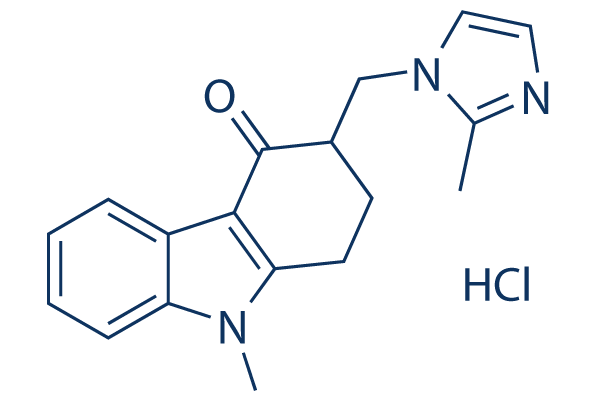
Chemische structuur
Molecuulgewicht: 329.82
Kwaliteitscontrole (Quality Control)
| Gerelateerde doelwitten | Adrenergic Receptor AChR COX Calcium Channel Histamine Receptor Dopamine Receptor GABA Receptor TRP Channel Cholinesterase (ChE) GluR |
|---|---|
| Overig 5-HT Receptor Inhibitoren | Serotonin Hydrochloride (5-HT HCl) WAY-100635 Maleate Puerarin SB269970 HCl Ketanserin BRL-15572 Dihydrochloride RS-127445 Nuciferine Flopropione BRL-54443 |
Chemische informatie, opslag en stabiliteit (Chemical Information, Storage & Stability)
| Molecuulgewicht | 329.82 | Formule | C18H19N3O.HCl |
Opslag (vanaf de datum van ontvangst) | |
|---|---|---|---|---|---|
| CAS-nr. | 99614-01-4 | SDF downloaden | Opslag van stamoplossingen |
|
|
| Synoniemen | GR 38032F,SN 307 | Smiles | CC1=NC=CN1CC2CCC3=C(C2=O)C4=CC=CC=C4N3C.Cl | ||
Oplosbaarheid (Solubility)
|
In vitro |
Water : 166 mg/mL
DMSO
: 66 mg/mL
(200.1 mM)
Ethanol : 13 mg/mL |
Molariteitscalculator
|
In vivo |
|||||
In vivo formulatiecalculator (heldere oplossing)
Stap 1: Voer onderstaande informatie in (Aanbevolen: een extra dier om rekening te houden met verlies tijdens het experiment)
Stap 2: Voer de in vivo formulering in (Dit is alleen de calculator, geen formulering. Neem eerst contact met ons op als er geen in vivo formulering is in de sectie oplosbaarheid.)
Berekeningsresultaten:
Werkconcentratie: mg/ml;
Methode voor het bereiden van DMSO-moedervloeistof: mg geneesmiddel vooropgelost in μL DMSO ( Concentratie moedervloeistof mg/mL, Neem eerst contact met ons op als de concentratie de DMSO-oplosbaarheid van de batch van het geneesmiddel overschrijdt. )
Methode voor het bereiden van in vivo formulering: Neem μL DMSO moedervloeistof, voeg daarna toeμL PEG300, mengen en verhelderen, daarna toevoegenμL Tween 80, mengen en verhelderen, daarna toevoegen μL ddH2O, mengen en verhelderen.
Methode voor het bereiden van in vivo formulering: Neem μL DMSO moedervloeistof, voeg daarna toe μL Maïsolie, mengen en verhelderen.
Opmerking: 1. Zorg ervoor dat de vloeistof helder is voordat u het volgende oplosmiddel toevoegt.
2. Zorg ervoor dat u het/de oplosmiddel(en) in de juiste volgorde toevoegt. U moet ervoor zorgen dat de verkregen oplossing, bij de vorige toevoeging, een heldere oplossing is voordat u verdergaat met het toevoegen van het volgende oplosmiddel. Fysieke methoden zoals vortexen, ultrasoon of een warmwaterbad kunnen worden gebruikt om het oplossen te bevorderen.
Werkingsmechanisme (Mechanism of Action)
| Targets/IC50/Ki |
5-HT3
|
|---|---|
| In vivo |
Ondansetron decreases the intensity of withdrawal signs such as increased defecation, jumping and wet-dog shakes, elevated the nociceptive threshold values which are decreased by precipitated withdrawal, but produces no change in urination, rectal temperature or salivation. Ondansetron and granisetron significantly enhances gastric emptying of glass beads and improves cisplatin-induced slowing of gastric emptying in rats. Ondansetron exhibits a biphasic dose-response profile in mice, with antidepressant-like effects peaking at 0.1 mg/kg, in the forced swim and tail suspension tests. Ondansetron pretreatment augments the antidepressant effects of fluoxetine and venlafaxine but does not influence the effects of desipramine or 8-hydroxy-2-(di-n-propylamino) tetralin. Ondansetron (10 mg/kg) reverses hyperactivity in the open field, and decreases the percentage entry and time spent in open arms in the elevated plus maze. Ondansetron, a selective and potent 5HT3 receptor antagonist, is shown to be effective at blocking the amphetamine-induced disruption of LI at a dose of 0.01 mg/kg, but not at 0.1 mg/kg. Ondansetron is able to attenuate increases in dopamine activity, produces pharmacologically with amphetamine without affecting baseline dopamine activity. Ondansetron facilitates performance in young adult and aged animals, and inhibits an impairment in habituation induced by scopolamine, electrolesions or ibotenic acid lesions of the nucleus basalis magnocellularis. Ondansetron and arecoline antagonizes a scopolamine-induced impairment. |
Referenties |
|
Informatie over klinische proeven (Clinical Trial Information)
(gegevens van https://clinicaltrials.gov, bijgewerkt op 2026-08-20)
| NCT-nummer | Werving | Aandoeningen | Sponsor/medewerkers | Startdatum | Fasen |
|---|---|---|---|---|---|
| NCT07777276 | NOT_YET_RECRUITING | Postoperative Sleep Quality; Postoperative Behaviour; Postoperative Recovery in Children; Postoperative Nausea and Vomiting (PONV); Paediatric Surgery; Anaesthesia |
Telethon Kids Institute |
2026-08-17 | PHASE4 |
| NCT07588217 | NOT_YET_RECRUITING | ARDS (Acute Respiratory Distress Syndrome); Invasive Mechanical Ventilation; Patient-Self Inflicted Lung Injury |
Centre Integre Universitaire de Sante et Services Sociaux du Nord de l'ile de Montreal |
2026-10-01 | PHASE2; PHASE3 |
| NCT05784350 | NOT_YET_RECRUITING | Intra-operative Hypotension |
Meir Medical Center |
2025-08-01 | |
| NCT03865290 | RECRUITING | Indigestion; Diabetes Mellitus |
Mayo Clinic |
2019-04-02 | PHASE2 |
| NCT05844501 | RECRUITING | Atrial Fibrillation |
Indiana University |
2025-04-22 | PHASE4 |
| NCT07795060 | NOT_YET_RECRUITING | Cholera (Disorder) |
Public Interest Science Center |
2027-03-01 | PHASE2 |

Producten zijn uitsluitend voor onderzoeksdoeleinden. Niet voor menselijk gebruik. Wij verkopen niet aan patiënten.
©Copyright 2013 Selleck Chemicals. Alle rechten voorbehouden.