
alleen voor onderzoeksdoeleinden
Levodopa Dopamine Receptor Agonist
Cat.nr.: S1726
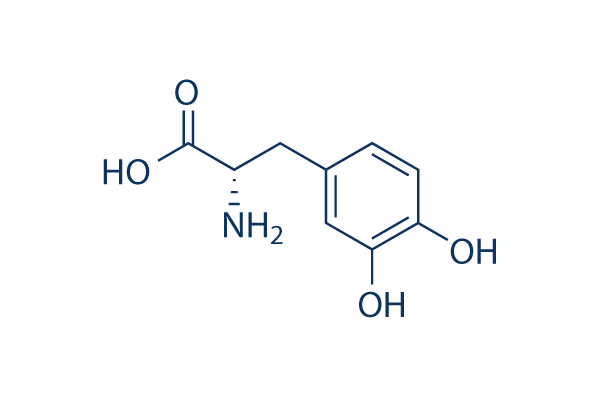
Chemische structuur
Molecuulgewicht: 197.19
Kwaliteitscontrole (Quality Control)
| Gerelateerde doelwitten | Adrenergic Receptor AChR 5-HT Receptor COX Calcium Channel Histamine Receptor GABA Receptor TRP Channel Cholinesterase (ChE) GluR |
|---|---|
| Overig Dopamine Receptor Inhibitoren | MPTP Hydrochloride Trifluoperazine Trifluoperazine 2HCl Penfluridol Rotundine Domperidone Sulpiride Azaperone Levosulpiride SCH-23390 hydrochloride |
Chemische informatie, opslag en stabiliteit (Chemical Information, Storage & Stability)
| Molecuulgewicht | 197.19 | Formule | C9H11NO4 |
Opslag (vanaf de datum van ontvangst) | |
|---|---|---|---|---|---|
| CAS-nr. | 59-92-7 | SDF downloaden | Opslag van stamoplossingen |
|
|
| Synoniemen | L-DOPA | Smiles | C1=CC(=C(C=C1CC(C(=O)O)N)O)O | ||
Oplosbaarheid (Solubility)
|
In vitro |
5%TFA : 6.03 mg/mL
DMSO
: Insoluble
Water : Insoluble |
Molariteitscalculator
|
In vivo |
|||||
In vivo formulatiecalculator (heldere oplossing)
Stap 1: Voer onderstaande informatie in (Aanbevolen: een extra dier om rekening te houden met verlies tijdens het experiment)
Stap 2: Voer de in vivo formulering in (Dit is alleen de calculator, geen formulering. Neem eerst contact met ons op als er geen in vivo formulering is in de sectie oplosbaarheid.)
Berekeningsresultaten:
Werkconcentratie: mg/ml;
Methode voor het bereiden van DMSO-moedervloeistof: mg geneesmiddel vooropgelost in μL DMSO ( Concentratie moedervloeistof mg/mL, Neem eerst contact met ons op als de concentratie de DMSO-oplosbaarheid van de batch van het geneesmiddel overschrijdt. )
Methode voor het bereiden van in vivo formulering: Neem μL DMSO moedervloeistof, voeg daarna toeμL PEG300, mengen en verhelderen, daarna toevoegenμL Tween 80, mengen en verhelderen, daarna toevoegen μL ddH2O, mengen en verhelderen.
Methode voor het bereiden van in vivo formulering: Neem μL DMSO moedervloeistof, voeg daarna toe μL Maïsolie, mengen en verhelderen.
Opmerking: 1. Zorg ervoor dat de vloeistof helder is voordat u het volgende oplosmiddel toevoegt.
2. Zorg ervoor dat u het/de oplosmiddel(en) in de juiste volgorde toevoegt. U moet ervoor zorgen dat de verkregen oplossing, bij de vorige toevoeging, een heldere oplossing is voordat u verdergaat met het toevoegen van het volgende oplosmiddel. Fysieke methoden zoals vortexen, ultrasoon of een warmwaterbad kunnen worden gebruikt om het oplossen te bevorderen.
Werkingsmechanisme (Mechanism of Action)
| Targets/IC50/Ki |
Dopamine receptor
|
|---|---|
| In vitro |
Levodopa produces at 25-200 μM concentrations a dose-dependent reduction of 3H-DA uptake in foetal rat midbrain cultures. This compound results in a decrease in the number of viable cells and tyrosine hydroxylase (TH) positive neurones, plus disruption of the overall neuritic network. It induces dyskinesia in the absence of dopamine by excessive inhibition of neurons of the putamen-globus pallidus (GPe) projection and subsequent disinhibition of the globus pallidus (GPe). This chemical results in a decrease in cytochrome oxidase messenger RNA expression in the globus pallidus (GPi). |
| In vivo |
Levodopa elicits the development of a variety of abnormal movements in monkeys with parkinsonism induced by the neurotoxin MPTP. This compound administrations result in an ectopic induction of the dopamine D3receptor expression in the CdPu in 6-OHDA-lesioned rats. This chemical (50 mg/kg) increases anandamide concentrations throughout thebasal ganglia via activation of dopamine D1/D2 receptors in intact rats. It produces increasingly severe oro-lingual involuntary movements which are attenuated by the cannabinoid agonist R(+)-WIN55,212-2 (1 mg/kg) in lesioned rats. This compound administration reverses the up-regulation of D2 dopamine receptors seen in severely lesioned rats provided evidence that it reaches a biologically active concentration at the basal ganglia. |
Referenties |
|
Informatie over klinische proeven (Clinical Trial Information)
(gegevens van https://clinicaltrials.gov, bijgewerkt op 2026-07-13)
| NCT-nummer | Werving | Aandoeningen | Sponsor/medewerkers | Startdatum | Fasen |
|---|---|---|---|---|---|
| NCT07151378 | RECRUITING | PARKINSON DISEASE (Disorder) |
University Hospital Tuebingen |
2025-10-27 | PHASE3 |
| NCT07793461 | NOT_YET_RECRUITING | Parkinson's Disease |
Beth Israel Deaconess Medical Center |
2027-07 | PHASE4 |
| NCT06891781 | NOT_YET_RECRUITING | Parkinson Disease, Idiopathic |
Newronika |
2026-08 | |
| NCT07781696 | NOT_YET_RECRUITING | Freezing of Gait Symptoms in Parkinson Disease |
Iahn Cajigas |
2026-09 | |
| NCT06013956 | RECRUITING | Parkinson Disease |
David Escobar |
2023-08-29 | PHASE4 |
| NCT05285683 | RECRUITING | Chronic Pain |
University of Rochester |
2024-01-31 | PHASE2 |

Producten zijn uitsluitend voor onderzoeksdoeleinden. Niet voor menselijk gebruik. Wij verkopen niet aan patiënten.
©Copyright 2013 Selleck Chemicals. Alle rechten voorbehouden.