
alleen voor onderzoeksdoeleinden
Chelerythrine Chloride (NSC 646662) PKC Remmer
Cat.nr.: S1292
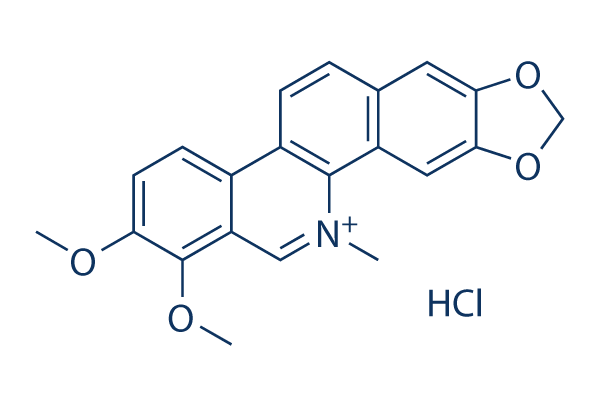
Chemische structuur
Molecuulgewicht: 384.83
Kwaliteitscontrole (Quality Control)
Chemische informatie, opslag en stabiliteit (Chemical Information, Storage & Stability)
| Molecuulgewicht | 384.83 | Formule | C21H18NO4.HCl |
Opslag (vanaf de datum van ontvangst) | |
|---|---|---|---|---|---|
| CAS-nr. | 3895-92-9 | SDF downloaden | Opslag van stamoplossingen |
|
|
| Synoniemen | Broussonpapyrine chloride | Smiles | C[N+]1=C2C(=C3C=CC(=C(C3=C1)OC)OC)C=CC4=CC5=C(C=C42)OCO5.[Cl-] | ||
Oplosbaarheid (Solubility)
|
In vitro |
DMSO
: 3 mg/mL
(7.79 mM)
Water : Insoluble Ethanol : Insoluble |
Molariteitscalculator
|
In vivo |
|||||
In vivo formulatiecalculator (heldere oplossing)
Stap 1: Voer onderstaande informatie in (Aanbevolen: een extra dier om rekening te houden met verlies tijdens het experiment)
Stap 2: Voer de in vivo formulering in (Dit is alleen de calculator, geen formulering. Neem eerst contact met ons op als er geen in vivo formulering is in de sectie oplosbaarheid.)
Berekeningsresultaten:
Werkconcentratie: mg/ml;
Methode voor het bereiden van DMSO-moedervloeistof: mg geneesmiddel vooropgelost in μL DMSO ( Concentratie moedervloeistof mg/mL, Neem eerst contact met ons op als de concentratie de DMSO-oplosbaarheid van de batch van het geneesmiddel overschrijdt. )
Methode voor het bereiden van in vivo formulering: Neem μL DMSO moedervloeistof, voeg daarna toeμL PEG300, mengen en verhelderen, daarna toevoegenμL Tween 80, mengen en verhelderen, daarna toevoegen μL ddH2O, mengen en verhelderen.
Methode voor het bereiden van in vivo formulering: Neem μL DMSO moedervloeistof, voeg daarna toe μL Maïsolie, mengen en verhelderen.
Opmerking: 1. Zorg ervoor dat de vloeistof helder is voordat u het volgende oplosmiddel toevoegt.
2. Zorg ervoor dat u het/de oplosmiddel(en) in de juiste volgorde toevoegt. U moet ervoor zorgen dat de verkregen oplossing, bij de vorige toevoeging, een heldere oplossing is voordat u verdergaat met het toevoegen van het volgende oplosmiddel. Fysieke methoden zoals vortexen, ultrasoon of een warmwaterbad kunnen worden gebruikt om het oplossen te bevorderen.
Werkingsmechanisme (Mechanism of Action)
| Kenmerken |
Chelerythrine is at least 100-fold more selective for PKCs than for other kinases.
|
|---|---|
| Targets/IC50/Ki |
PKC
(Cell-free assay) 0.66 μM
|
| In vitro |
Chelerythrine Chloride (NSC 646662) interacts with the catalytic domain of PKC, is a competitive inhibitor with respect to the phosphate acceptor (histone IIIS) with Ki value of 0.7 μM and a non-competitive inhibitor with respect to ATP. It shows potent cytotoxic effects against L-1210 cells with IC50 of 0.53 μM. This compound does not alter any activity of PKA, TPK and Ca/CM-PK, and its inhibitory effect on PKC activity does not vary among the various substrates including GS, MLC, MBP and Fibrinogen. It inhibits PKC activity in crude cell extracts from SQ-20B cells in a dose dependent manner. Chelerythrine decreases cell viability as determined by the MTT assay in a dose-dependent manner in SCC35, JSQ3, SQ20B and SCC61 cells. At 5 μM, it suppresses VEGF-induced expression of ICAM-1, VCAM-1, and E-selectin in HUVECs. It also suppresses VEGF-induced NF-κB activity in HUVECs at the same concentration and all suppresses basal and VEGF-induced leukocyte adhesiveness in HUVECs. At concentrations of 6 mM-30 mM, it rapidly induces pyknosis, shrinkage and subsequent cell death in cardiac myocytes. Chelerythrine(30 μM)-induced myocyte death is accompanied by nuclear fragmentation and activation of caspase-3 and -9 in primary culture of neonatal rat ventricular myocytes. At 10 μM, it causes cytochrome c release from mitochondria, suggesting that ROS mediates chelerythrine-induced cytochrome c release in cardiac myocytes. It displaces the fluorescently labeled BH3 domain peptide from a recombinant GST-BcLXL fusion protein with IC50 of 1.5 μM. At 2.5 μM and 5 μM for 16 hours, it induces a substantial decrease in mitochondrial potential as indicated by an increase in JC-1 green fluorescence in human neuroblastoma SH-SY5Y cells. At 5 μM, it also induces the appearance of sub-G1 DNA that is indicative of apoptosis in SH-SY5Y cells. At 10 μM, it induces mitochondrial potential change, CytC release from the mitochondria in SH-SY5Y cells. |
| Kinase Assay |
assay voor proteïnekinase C
|
|
De gezuiverde proteïnekinase C wordt bereid uit rattenhersenen. Kortom, het incubatiemengsel (200 μL) bevat 20 mM Tris/HCl-buffer (pH 7,5), 10 mM MgCl2, 200 μg/mL histonen, micellen gemaakt met 700 μM fosfatidylserine en 180 μM 1,2-dioleine in 0,3% triton X100, 0,2 mM CaCl2, 100 μM ATP, [γ-32P ]-ATP (105 dpm), te testen Chelerythrine Chloride (NSC 646662) (opgelost in dimethylsulfoxide) en het enzym (0,5 μg eiwit). Na incubatie bij 30℃ gedurende 3 minuten wordt de reactie beëindigd door de toevoeging van 3 mL 20% trichloorazijnzuur. Zuurprecipiteerbare materialen worden verzameld op Whatman GFE-filters en uitgebreid gewassen met ijskoud 20% trichloorazijnzuur. De radioactiviteit op de filters wordt gemeten met een vloeistofscintillatieteller. Proteïnekinase C-activiteit wordt gecorrigeerd voor niet-specifieke activiteit door te testen in afwezigheid van micellen en CaCl2.
|
|
| In vivo |
Chelerythrine Chloride (NSC 646662) (5 mg/kg i.p.) results in tumor growth delay in mice bearing SQ-20B xenografts. This compound (5 mg/kg) treatment significantly increases TUNEL-positive nuclei in the myocardium as well as cleaved forms of caspase-3 and -9 in adult rat. |
Referenties |
|

Producten zijn uitsluitend voor onderzoeksdoeleinden. Niet voor menselijk gebruik. Wij verkopen niet aan patiënten.
©Copyright 2013 Selleck Chemicals. Alle rechten voorbehouden.