
alleen voor onderzoeksdoeleinden
Aprepitant Neurokinin Receptor Antagonist
Cat.nr.: S1189
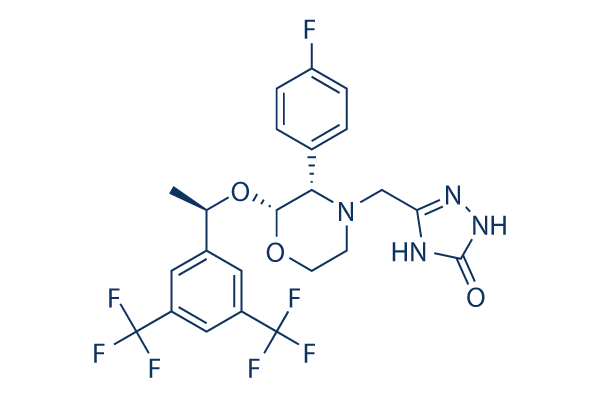
Chemische structuur
Molecuulgewicht: 534.43
Kwaliteitscontrole (Quality Control)
| Gerelateerde doelwitten | Adrenergic Receptor AChR 5-HT Receptor COX Calcium Channel Histamine Receptor Dopamine Receptor GABA Receptor TRP Channel Cholinesterase (ChE) |
|---|---|
| Overig Neurokinin Receptor Inhibitoren | L-732138 Fezolinetant Maropitant citrate Asparagus Extract Tradipitant Substance P Elinzanetant |
Celkweek, behandeling & werkzame concentratie
(Cell Culture, Treatment & Working Concentration)
| Cellijnen | Assaytype | Concentratie | Incubatietijd | Formulering | Activiteitsbeschrijving | PMID |
|---|---|---|---|---|---|---|
| CHO cells | Function assay | Displacement of [125I]SP from human NK1 receptor expressed in CHO cells, IC50=9e-05 μM | ||||
| HEK293 cell | Function assay | Displacement of [125I]-substance P from gerbil NK1 receptor expressed in HEK293 cell membranes incubated for 30 mins by liquid scintillation counting method, IC50=9e-05 μM | ||||
| HEK293 cell | Function assay | Noncompetitive inhibition of wild type human NK1 receptor expressed in HEK293 cells assessed as decrease in SP1-induced [3H]IP accumulation after 20 mins | ||||
| Klik om meer experimentele gegevens over cellijnen te bekijken | ||||||
Chemische informatie, opslag en stabiliteit (Chemical Information, Storage & Stability)
| Molecuulgewicht | 534.43 | Formule | C23H21F7N4O3 |
Opslag (vanaf de datum van ontvangst) | |
|---|---|---|---|---|---|
| CAS-nr. | 170729-80-3 | SDF downloaden | Opslag van stamoplossingen |
|
|
| Synoniemen | MK-0869, L-754030 | Smiles | CC(C1=CC(=CC(=C1)C(F)(F)F)C(F)(F)F)OC2C(N(CCO2)CC3=NNC(=O)N3)C4=CC=C(C=C4)F | ||
Oplosbaarheid (Solubility)
|
In vitro |
DMSO
: 107 mg/mL
(200.21 mM)
Ethanol : 15 mg/mL Water : Insoluble |
Molariteitscalculator
|
In vivo |
|||||
In vivo formulatiecalculator (heldere oplossing)
Stap 1: Voer onderstaande informatie in (Aanbevolen: een extra dier om rekening te houden met verlies tijdens het experiment)
Stap 2: Voer de in vivo formulering in (Dit is alleen de calculator, geen formulering. Neem eerst contact met ons op als er geen in vivo formulering is in de sectie oplosbaarheid.)
Berekeningsresultaten:
Werkconcentratie: mg/ml;
Methode voor het bereiden van DMSO-moedervloeistof: mg geneesmiddel vooropgelost in μL DMSO ( Concentratie moedervloeistof mg/mL, Neem eerst contact met ons op als de concentratie de DMSO-oplosbaarheid van de batch van het geneesmiddel overschrijdt. )
Methode voor het bereiden van in vivo formulering: Neem μL DMSO moedervloeistof, voeg daarna toeμL PEG300, mengen en verhelderen, daarna toevoegenμL Tween 80, mengen en verhelderen, daarna toevoegen μL ddH2O, mengen en verhelderen.
Methode voor het bereiden van in vivo formulering: Neem μL DMSO moedervloeistof, voeg daarna toe μL Maïsolie, mengen en verhelderen.
Opmerking: 1. Zorg ervoor dat de vloeistof helder is voordat u het volgende oplosmiddel toevoegt.
2. Zorg ervoor dat u het/de oplosmiddel(en) in de juiste volgorde toevoegt. U moet ervoor zorgen dat de verkregen oplossing, bij de vorige toevoeging, een heldere oplossing is voordat u verdergaat met het toevoegen van het volgende oplosmiddel. Fysieke methoden zoals vortexen, ultrasoon of een warmwaterbad kunnen worden gebruikt om het oplossen te bevorderen.
Werkingsmechanisme (Mechanism of Action)
| Targets/IC50/Ki |
G-CSF
IL-6
IL-8
TNFα
Neurokinin-1 receptor
(Cell-free assay) 0.1 nM
|
|---|---|
| In vitro |
Aprepitant antagonizes the effects of substance P by binding to NK-1 receptors primarily in the CNS, but also in the periphery. This compound, at concentrations of 0.1 nM displaces 50% of substance P from hNK1 receptors transfected in CHO or COS cells. In radioligand binding assays, it is 3000-fold selective for the human cloned NK1 receptor versus the human cloned NK3 receptor and >50,000-fold selective over the human cloned NK2 receptor. In a range of assays at other human cloned G–protein coupled receptors, this chemical retains >50,000-fold selectivity for the human cloned NK1 receptor. It is inactive in human monoamine oxidase A and B assays and at human serotonin 5–HT1A, 5–HT2A, 5–HT2c, 5–HT3, 5–HT5, 5–HT6, and 5–HT7 receptors (IC50>3 μM). In the PANLABS panel of radioligand binding screens using native animal tissues, this compound inhibits [3H]substance P binding to native NK1 receptors in rat submaxillary gland; there are no significant interactions of it with any other native animal G–protein coupled receptors or ion channels examined in the PANLABS screen. It is inactive in monoamine uptake site (NE, 5–HT, DA) counterscreens using human and animal tissues (IC50> 3 μM) |
| In vivo |
Aprepitant crosses the blood–brain barrier and occupied NK-1 receptors in the brain. This compound has been shown to inhibit both acute and delayed emesis induced by cytotoxic chemotherapeutic such as cisplatin by blocking substance P. It (3 mg/kg i.v. or p.o.) inhibits the emetic response to cisplatin (10 mg/kg i.v.). The anti-emetic protection afforded by this chemical (0.1 mg/kg i.v.) is enhanced by combined treatment with either dexamethasone (20 mg/kg i.v.) or the 5–HT3 receptor antagonist ondansetron (0.1 mg/kg i.v.). In a model of acute and delayed emesis, ferrets are dosed with cisplatin (5 mg/kg i.p.) and the retching and vomiting response recorded for 72 h. Pretreatment with it (4–16 mg/kg p.o.) dose-dependently inhibits the emetic response to cisplatin. Once daily treatment with this compound (2 and 4 mg/kg p.o.) completely prevents retching and vomiting in all ferrets tested. Further when daily dosing began at 24 h after cisplatin injection, when the acute phase of emesis had already become established, it (4 mg/kg p.o. at 24 and 48 h after cisplatin) prevents retching and vomiting in three out of four ferrets. This chemical also plays a key part in transmission of pain impulses from the peripheral receptors to the CNS and is involved in various behavioural, neurochemical and cardiovascular responses to stress. |
Referenties |
|
Informatie over klinische proeven (Clinical Trial Information)
(gegevens van https://clinicaltrials.gov, bijgewerkt op 2023-05-03)
| NCT-nummer | Werving | Aandoeningen | Sponsor/medewerkers | Startdatum | Fasen |
|---|---|---|---|---|---|
| NCT05841849 | NOT_YET_RECRUITING | Breast Cancer; Chemotherapy-induced Nausea and Vomiting |
Second Affiliated Hospital, Zhejiang University, School of Medicine |
2023-07 | PHASE4 |
| NCT06740812 | NOT_YET_RECRUITING | Nausea and Vomiting; Nausea; Vomiting |
Montefiore Medical Center |
2026-12 | PHASE4 |
| NCT07662200 | NOT_YET_RECRUITING | Germ Cell Cancer |
Ottawa Hospital Research Institute |
2026-08 | EARLY_PHASE1 |
| NCT07639723 | NOT_YET_RECRUITING | PONV |
Endeavor Health |
2026-07 | PHASE4 |
| NCT06462287 | RECRUITING | Apnea, Obstructive |
University Hospital, Rouen |
2024-03-05 | PHASE2 |
| NCT07371728 | NOT_YET_RECRUITING | Otologic Disease |
Sir Mortimer B. Davis - Jewish General Hospital |
2026-06-01 | PHASE4 |

Producten zijn uitsluitend voor onderzoeksdoeleinden. Niet voor menselijk gebruik. Wij verkopen niet aan patiënten.
©Copyright 2013 Selleck Chemicals. Alle rechten voorbehouden.