
alleen voor onderzoeksdoeleinden
AG-14361 PARP Remmer
Cat.nr.: S2178
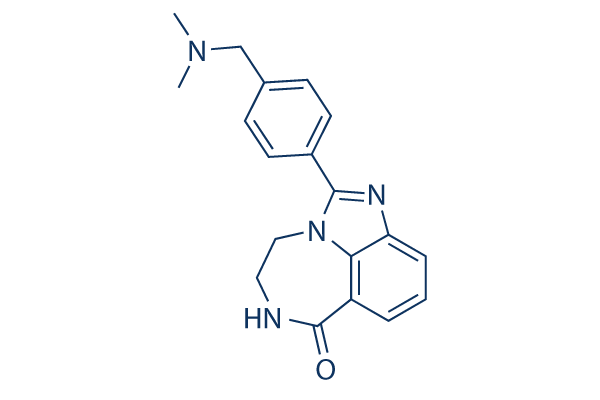
Chemische structuur
Molecuulgewicht: 320.39
Kwaliteitscontrole (Quality Control)
| Gerelateerde doelwitten | HDAC ATM/ATR DNA-PK WRN DNA/RNA Synthesis Topoisomerase PPAR Sirtuin Casein Kinase eIF |
|---|---|
| Overig PARP Inhibitoren | XAV-939 AZD5305 (Saruparib) Veliparib (ABT-888) PJ34 HCl Iniparib (BSI-201) G007-LK A-966492 UPF 1069 Pamiparib ME0328 |
Celkweek, behandeling & werkzame concentratie
(Cell Culture, Treatment & Working Concentration)
| Cellijnen | Assaytype | Concentratie | Incubatietijd | Formulering | Activiteitsbeschrijving | PMID |
|---|---|---|---|---|---|---|
| LoVo cells | Function assay | Concentration that gives 50% growth inhibition in LoVo cells, activity expressed as GI50, GI50=11.2 μM | ||||
| Klik om meer experimentele gegevens over cellijnen te bekijken | ||||||
Chemische informatie, opslag en stabiliteit (Chemical Information, Storage & Stability)
| Molecuulgewicht | 320.39 | Formule | C19H20N4O |
Opslag (vanaf de datum van ontvangst) | |
|---|---|---|---|---|---|
| CAS-nr. | 328543-09-5 | SDF downloaden | Opslag van stamoplossingen |
|
|
| Synoniemen | N/A | Smiles | CN(C)CC1=CC=C(C=C1)C2=NC3=CC=CC4=C3N2CCNC4=O | ||
Oplosbaarheid (Solubility)
|
In vitro |
DMSO
: 51 mg/mL
(159.18 mM)
Ethanol : 21 mg/mL Water : Insoluble |
Molariteitscalculator
|
In vivo |
|||||
In vivo formulatiecalculator (heldere oplossing)
Stap 1: Voer onderstaande informatie in (Aanbevolen: een extra dier om rekening te houden met verlies tijdens het experiment)
Stap 2: Voer de in vivo formulering in (Dit is alleen de calculator, geen formulering. Neem eerst contact met ons op als er geen in vivo formulering is in de sectie oplosbaarheid.)
Berekeningsresultaten:
Werkconcentratie: mg/ml;
Methode voor het bereiden van DMSO-moedervloeistof: mg geneesmiddel vooropgelost in μL DMSO ( Concentratie moedervloeistof mg/mL, Neem eerst contact met ons op als de concentratie de DMSO-oplosbaarheid van de batch van het geneesmiddel overschrijdt. )
Methode voor het bereiden van in vivo formulering: Neem μL DMSO moedervloeistof, voeg daarna toeμL PEG300, mengen en verhelderen, daarna toevoegenμL Tween 80, mengen en verhelderen, daarna toevoegen μL ddH2O, mengen en verhelderen.
Methode voor het bereiden van in vivo formulering: Neem μL DMSO moedervloeistof, voeg daarna toe μL Maïsolie, mengen en verhelderen.
Opmerking: 1. Zorg ervoor dat de vloeistof helder is voordat u het volgende oplosmiddel toevoegt.
2. Zorg ervoor dat u het/de oplosmiddel(en) in de juiste volgorde toevoegt. U moet ervoor zorgen dat de verkregen oplossing, bij de vorige toevoeging, een heldere oplossing is voordat u verdergaat met het toevoegen van het volgende oplosmiddel. Fysieke methoden zoals vortexen, ultrasoon of een warmwaterbad kunnen worden gebruikt om het oplossen te bevorderen.
Werkingsmechanisme (Mechanism of Action)
| Kenmerken |
The 1st high-potency PARP-1 inhibitor with the specificity & in vivo activity to enhance chemotherapy and radiation therapy of human cancers.
|
|---|---|
| Targets/IC50/Ki |
PARP1
(Cell-free assay) <5 nM(Ki)
|
| In vitro |
AG14361 is at least 1000-fold more potent than the benzamides. The IC50 for AG14361 is 29 nM in permeabilized SW620 cells and 14 nM in intact SW620 cells. Crystallographic analysis of AG14361 bound to the catalytic domain of chicken PARP-1 shows that the tricyclic ring system of AG14361 is located in a pocket composed of amino acid residues Trp861, His862, Gly863, Tyr896, Phe897, Ala898, Lys903, Ser904, Tyr907, and Glu988. AG14361 forms important hydrogen bonds with Ser904 and Gly863 and a water-mediated hydrogen bond with Glu988. AG14361-induced growth inhibition is not attributed to PARP-1-related effects because maximal PARP-1 inhibition is observed at much lower concentrations (≤1 μM) than the GI50. AG14361 at 0.4 μM does not affect cancer cell gene expression or growth, but it increases the antiproliferative activity, and inhibits recovery from potentially lethal γ-radiation damage in LoVo cells by 73%. In addition, 0.4 μM AG14361 does not substantially alter gene expression as shown by microarray analysis. A 17-hour exposure of A549 cells to 0.4 μM AG14361 does not change the expression of the 6800 genes. Thus, although 0.4 μM AG14361 inhibits cellular PARP-1 activity by more than 85%, it essentially does not change gene expression and cell proliferation, indicating that the cellular effects of this low concentration of AG14361 are specific for PARP-1 inhibition. Higher, growth-inhibitory concentrations of AG14361 affects gene expression, but these effects are not likely to be related to PARP-1 inhibition because cell proliferation is affected equally in PARP-/- and PARP-1+/+ cells. AG14361 is rapidly absorbed into the bloodstream and distributed to the tumor and liver with lower concentrations detected in the brain. Tissue-to-plasma concentration ratio indicates that AG14361 is retained in tumor tissue over time in both xenograft models, with tumor concentrations (≥15 μM for 2 hours) in excess of that required to inhibit PARP-1 activity in vitro. AG14361 enhances activity in all MMR-proficient cells (1.5–3.3-fold) but is more effective in MMR-deficient cells (3.7–5.2-fold potentiation), overcoming resistance. In contrast, benzylguanine only increases the efficacy in MMR-proficient cells but is ineffective in MMR-deficient cells. AG14361 enhances the growth-inhibitory and cytotoxic effects of topoisomerase I poisons. AG14361 increases the persistence of camptothecin-induced DNA single-strand breaks. |
| Kinase Assay |
PARP-1 Activiteitsassays
|
|
De activiteit van full-length recombinant humaan PARP-1 wordt gemeten in een reactiemengsel dat 20 nM PARP-1, 500 μM NAD+ plus [32P]NAD+ (0,1–0,3 μCi per reactiemengsel), en geactiveerd kalfs-thymus-DNA (10 μg/mL) bij 25oC bevat; de reactie wordt na 4 minuten beëindigd door toevoeging van ijskoude 10% (gew./vol.) trichloorazijnzuur. Het reactieproduct [32P]ADP-ribose, opgenomen in zuur-onoplosbaar materiaal, wordt afgezet op Whatman GF/C glasvezelfilters met een Bio-Dot microfiltratieapparaat en gekwantificeerd met een PhosphorImager. Remming van PARP-1-activiteit door AG14361 bij 0–600 nM wordt gemeten, en de Ki voor AG14361 wordt berekend door niet-lineaire regressieanalyse.
|
|
| In vivo |
AG14361 treatment before irradiation statistically significantly increases the sensitivity to radiation therapy of mice bearing LoVo xenografts. AG14361 statistically significantly increases blood flow in xenografts and thus potentially increases drug delivery to tumor xenografts. In vivo, nontoxic doses of AG14361 increases the delay of LoVo xenograft growth induced by x-irradiation by 2- to 3-fold. Coadministration of AG14361 statistically significantly increases activity against LoVo xenografts, with the tumor growth delay being increased from 3 days to 9 days by AG14361 at 5 mg/kg and to 10 days by AG14361 at 15 mg/kg. The combination of AG14361 causes complete regression of SW620 xenograft tumors. PARP-1 activity, detected by pharmacodynamic assay, in SW620 xenografts is inhibited by more than 75% for at least 4 hours after intraperitoneal administration of AG14361 (10 mg/kg), consistent with the concentration of AG14361 persisting in the tumor. |
Referenties |
|

Producten zijn uitsluitend voor onderzoeksdoeleinden. Niet voor menselijk gebruik. Wij verkopen niet aan patiënten.
©Copyright 2013 Selleck Chemicals. Alle rechten voorbehouden.