
Technische gegevens
| Formule | C31H43N3O8 |
||||||
| Molecuulgewicht | 585.69 | CAS-nr. | 75747-14-7 | ||||
| Oplosbaarheid (25°C)* | In vitro | DMSO | 117 mg/mL (199.76 mM) | ||||
| Ethanol | 5 mg/mL (8.53 mM) | ||||||
| Water | Insoluble | ||||||
| In Vivo (Voeg oplosmiddelen afzonderlijk en in volgorde toe aan het product.) |
|
||||||
|
* <1 mg/ml betekent licht oplosbaar of onoplosbaar. * Houd er rekening mee dat Selleck de oplosbaarheid van alle verbindingen intern test en de werkelijke oplosbaarheid enigszins kan afwijken van gepubliceerde waarden. Dit is normaal en is te wijten aan lichte batch-tot-batch variaties. * Verzending op kamertemperatuur (Stabiliteitstests tonen aan dat dit product zonder koelmaatregelen kan worden verzonden.) |
|||||||
Voorbereiden van stamoplossingen
Biologische activiteit
| Beschrijving | Tanespimycin (17-AAG, CP127374, NSC-330507, KOS 953) is een krachtige HSP90-remmer met een IC50 van 5 nM in een celvrije test, met een 100-voudig hogere bindingsaffiniteit voor HSP90 afgeleid van tumorcellen dan HSP90 van normale cellen. Tanespimycin (17-AAG) induceert apoptosis, necrosis, autophagy en mitophagy. Fase 3. | ||
|---|---|---|---|
| Doelen |
|
||
| In vitro | Tanespimycin (17-AAG), een analoog van geldanamycine, vertoont een meer dan 100 keer hogere bindingsaffiniteit voor Hsp90 afgeleid van HER-2-overexpressieve kankercellen (BT474, N87, SKOV3 en SKBR3) of BT474 borstcarcinoomcellen met IC50-waarden van 5-6 nM. Deze verbinding veroorzaakt de afbraak van HER2, HER3, Akt en zowel mutante als wild-type androgeenreceptor (AR), wat leidt tot de RB-afhankelijke G1-groeiarrestatie van prostaatkankercellen zoals LNCaP, LAPC-4, DU-145 en PC-3 met IC50-waarden van 25-45 nM. Naast het induceren van apoptosis van Ba/F3-cellen getransformeerd met wild-type BCR-ABL met een IC50 van 5,2 M, heeft het het vermogen om apoptosis van cellen getransformeerd met T315I en E255K BCR-ABL-mutanten te induceren met IC50-waarden van respectievelijk 2,3 M en 1,0 M, door de afbraak van zowel wild-type BCR-ABL-eiwit als mutanten te induceren. |
||
| In Vivo | Tanespimycin (17-AAG) vertoont een significant hogere bindingsaffiniteit voor Hsp90 van 3T3-src-, B16- of CT26-xenografts bij naakte muizen met IC50-waarden van 8-35 nM, vergeleken met die van normale weefsels met IC50-waarden van 200-600 nM. Toediening van deze verbinding (~50 mg/kg) veroorzaakt een significante daling van de AR-, HER2-, HER3- en Akt-expressie op een dosisafhankelijke manier met >50% daling bij een dosis van 50 mg/kg, wat resulteert in de dosisafhankelijke remming van androgeenafhankelijke (CWR22) en -onafhankelijke (CWR22R en CWRSA6) prostaatkanker-xenografts-groei met respectievelijk 67%, 80% en 68% bij een dosis van 50 mg/kg. |
||
| Functies | Vertoont zeer lage toxiciteit voor normale cellen. |
Protocol (uit referentie)
| Kinase-assay: |
|
|---|---|
| Celassay: |
|
| Dierstudie: |
|
Referenties
|
Klantproductvalidatie
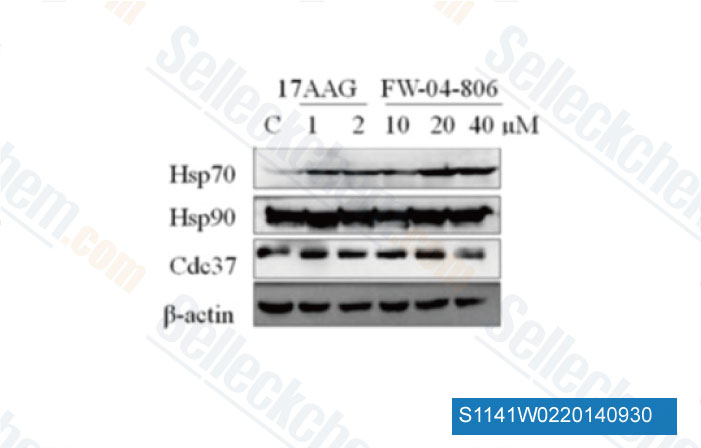
-
Gegevens van [ Mol Cancer , 2014 , 13, 150 ]
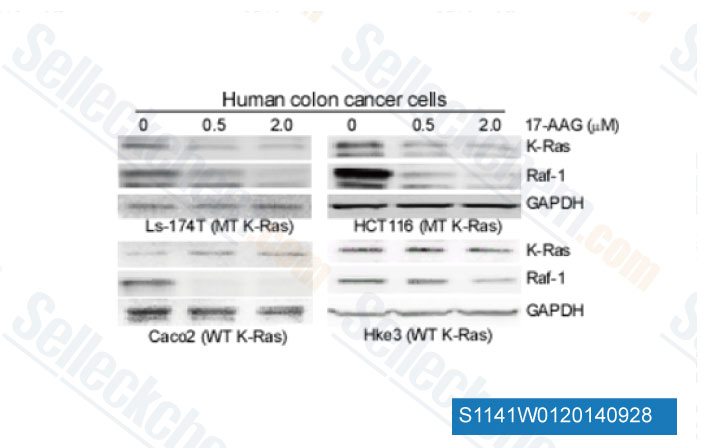
-
Gegevens van [ Oncotarget , 2014 , 5, 4269-82 ]
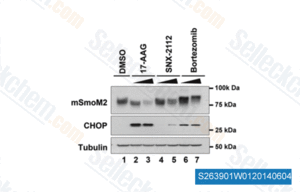
-
Gegevens van [ Mol Cell Biol , 2013 , 33(12), 2375-87 ]
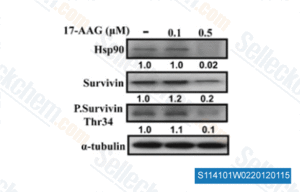
-
Gegevens van [ Age , 2013 , 35, 549-62 ]
Sellecks Tanespimycin (17-AAG) Is geciteerd door 152 Publicaties
| A patient-derived T cell lymphoma biorepository uncovers pathogenetic mechanisms and host-related therapeutic vulnerabilities [ Cell Rep Med, 2025, S2666-3791(25)00102-8] | PubMed: 40147445 |
| TBK1 is a signaling hub in coordinating stress-adaptive mechanisms in head and neck cancer progression [ Autophagy, 2025, 1-23.] | PubMed: 40114316 |
| NASP implication in the androgen receptor associated with castration resistance in prostate cancer [ Cell Commun Signal, 2025, 23(1):331] | PubMed: 40640803 |
| HSP90 deficiency promotes cholesteryl ester accumulation in lipid droplets via endocytosis of low-density lipoprotein [ Commun Biol, 2025, 8(1):1169] | PubMed: 40770403 |
| Heat shock protein 90 chaperone activity is required for hepatitis A virus replication [ J Virol, 2025, e0050225] | PubMed: 40470959 |
| Heat shock protein 90 chaperone activity is required for hepatitis A virus replication [ J Virol, 2025, 99(7):e0050225] | PubMed: 40470959 |
| Targeting HSP90 with Ganetespib to Induce CDK1 Degradation and Promote Cell Death in Hepatoblastoma [ Cancers (Basel), 2025, 17(8)1341] | PubMed: 40282517 |
| Topical application of the HSP90 inhibitor 17-AAG reduces skin inflammation and partially restores microbial balance: implications for atopic dermatitis therapy [ Sci Rep, 2025, 15(1):21245] | PubMed: 40593012 |
| Role of the NuRD complex and altered proteostasis in cancer cell quiescence [ bioRxiv, 2025, 2025.02.10.637435] | PubMed: 39990343 |
| Pan-cancer proteogenomics expands the landscape of therapeutic targets [ Cell, 2024, S0092-8674(24)00583-X] | PubMed: 38917788 |
RETOURBELEID
Selleck Chemicals onvoorwaardelijke retourbeleid zorgt voor een soepele online winkelervaring voor onze klanten. Als u op enigerlei wijze ontevreden bent met uw aankoop, kunt u elk artikel(en) binnen 7 dagen na ontvangst retourneren. In geval van problemen met de productkwaliteit, zowel protocolgerelateerde als productgerelateerde problemen, kunt u elk artikel(en) binnen 365 dagen na de oorspronkelijke aankoopdatum retourneren. Volg de onderstaande instructies bij het retourneren van producten.
VERZENDING EN OPSLAG
Selleck producten worden bij kamertemperatuur vervoerd. Als u het product op kamertemperatuur ontvangt, wees dan gerust, de Selleck kwaliteitsinspectieafdeling heeft experimenten uitgevoerd om te controleren of de normale temperatuurplaatsing van één maand de biologische activiteit van poederproducten niet beïnvloedt. Na ontvangst dient u het product op te slaan volgens de vereisten beschreven in het gegevensblad. De meeste Selleck producten zijn stabiel onder de aanbevolen omstandigheden.
NIET VOOR HUMANE, VETERINAIRE DIAGNOSTISCHE OF THERAPEUTISCHE DOELEINDEN.